
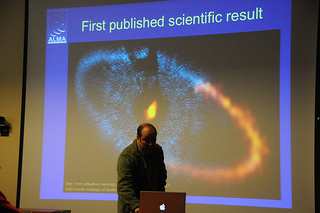
Over 50 researchers gathered on San Pedro de Atacama, invited by CMM with the aim of expose their investigations on the data management for the mining and astronomic industries.
Between 7and 10 of July was held the seventh version of Access Nova Forum-San Pedro deAtacama Symposium 2012, which reviewed the latest science of Mathematics andInformation Technologies (ICT), applied to Astronomy , Mining and Medicine.
The event,organized biennially by the Center forMathematical Modeling (CMM) of the Faculty of Physical Sciences and Mathematicsof University of Chile, San Pedro deAtacama brought together more than 50leaders of frontier research in ICT and networks.
Aligning the future
The main purpose of this meeting, says the researcherand co-chair CMM Forum, Eduardo Vera, is to connect and align scientific research issues and future challenges in various productive sectors.
Vera explains that mathematical modeling and applications of ICT has both increasing impacts on Astronomy,Mining and Biomedicine, due to the large amount of data that those áreas generates and requires analize.
“Although they are very diverse areas, from a mathematical computational and technological viewpoint, are all very similar. All handle a massive amount of data in terms of terabytes and petabytes. The nowadays challenge is to analyze and extract valuable information from such a giant ocean of data”, explains the researcher.
Collaborative projects
The Forumseeks to consolidate the Access Nova human collaboration network, generatingtrust between leading researchers from different disciplines, which enable thecreation of new initiatives and projects.
Forexample, Vera indicates there are some medical imaging algorithms that are usedin astronomical images, “This is the kind of synergies that we reach inthis swap.”
One of theresearch frontier of computing that attracted considerable attention duringthis forum, was the “machine to machine communication” and anemerging “social network” of machines.
Access NovaForum-San Pedro de Atacama Symposium 2012 was developed in collaboration withthe ALMA Project, AURA, REUNA, Fundación Chile y Micomo.
