
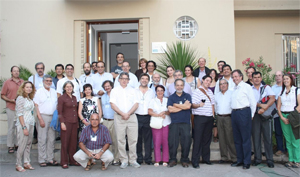
How to, effectively, influence public policy, training of teachers and students? It was the question that made the discussion and the ultimate goal of this meeting, held with support from ICSU-ROLAC (International Council for Science -Regional Office for Latin American and Caribbean), the Center for Mathematical Modeling (CMM), the Center for Advanced Research in Education (CIAE), and the Chilean Academy of Sciences.
For Patricio Felmer, CIAE researcher and Deputy Director of CMM at the University of Chile and one of the organizers of this initiative, the purpose of this meeting was to share experiences and ensure synergy to project in the future. “As mathematicians, we have a responsibility about Mathematics education and how to express this responsibility is not easy. The ultimate goal is for students, boys and girls who are learning Mathematics in the schools. This is our North, “he said.
According to José Antonio de la Peña, Mexican mathematician and member of the International Council for Science, the idea came four years ago in the context of Latin American scientific committee composed of representatives of the ICSU-ROLAC where they discussed the issues that should be addressed as transcendent in Latin America. Thus, after distinguish some of the difficulties facing the world, it was concluded that a major problem for Latin America and the Caribbean was Mathematics education, considering the importance of this discipline in all aspects of science and everyday life, on the one hand, and poor results were obtained in international assessments such as PISA and TIMSS, on the other.
So far, Mathematics education has begun to have strong resonance in the world, but still not enough. Therefore, acquired greater strength among the experts the idea of generating proposals and actions that could be done together to achieve greater impact. “In Latin America, said de la Peña, there are many efforts, but isolated and with varying degrees of success. Therefore, it is beneficial to know each other, they could see what they are doing, and we can organize a more unified, stronger movement. “
Coincident with the importance of the issue and the need to be addressed together, Leonor Varas, CMM and CIAE researcher at the University of Chile, was satisfied with the outcome of this meeting. “Common unresolved problems arose, which its collective analysis undoubtedly helps to find solutions better informed, with more projection, and to coordinate efforts to advance its implementation. The conference was very important, not only for the relevance of the topic, but because it allowed us to visualize a body of knowledge, experience, work teams, which has the potential to help address these challenges from a solid foundation with its own identity. Isolated experiences and go to join a body with greater density, “argued the academic.
“Teachers are the cornerstone of education”
A determining factor in the priority of this issue and has been the voice of warning to these professionals, have been the Latin American the poor results in international assessments. According to Carlos Bosh, the Autonomous Technological Institute of Mexico, “about what is Mathematics education, we are close to illiterate, we cannot solve problems on one step, we have difficulty interpreting statistical tables and young people who complete secondary education, has few tools to rely on life in general. “
For this academic, efforts to reverse this situation should focus on teachers. According to Bosh, there is a direct correlation between teachers who are better evaluated and thos students who perform better. “Teachers are the cornerstone of education. The students are many and they go by, but teachers are those who remain, it is crucial to do something to help them. The idea is that the mathematicians guide and help then and be involved in this process. “
Brazil: Examples of successful experiences in the region
Among the initiatives announced during this Congress, Brazil stood out with two successful experiences that have been part of the Brazilian government policies and, according to Patricio Felmer, “As Chileans, we must look very carefully to it.”
The first is the realization of National Mathematics Olympics for public school students, whose first version was developed in 2005. In this initiative participates 19 million students, almost 99% of public school students in that country.
The tournament takes place in two phases: the first, involving all students, and the second, only 5% of each school. “There are always surprises, said Felmer. Students cannot believe, and parents and teachers are surprised with the results and the children/students’ talent. ” In this stage, three thousand students receive medals and a scholarship for a course of scientific initiation, plus the ability to enter to the university.
The second initiative is the creation of a program to improve training for public school teachers where mathematicians of the most prestigious universities in Brazil participate. This program is aimed primarily at strengthening the content of Mathematics. “Teachers who enroll in this program have teaching experience, but no mathematical knowledge, so the main thing is the content rather than form to teach. The idea is: each public school teacher has a $ 700 scholarship to study, “said Vanderlei Horita, professor at the Universidade Estadual Paulista (UNESP) and secretary of the Brazilian Society of Mathematics, the agency that designed the program that lasts two years and the only requirement to apply to it is to be linked to a public school and comply, with the obligation, to remain in it 5 years after completing their studies.
According to Leonor Varas, Chile showed a significant range of outcomes, both scientific research and work with the Ministry of Education, companies, foundations, institutions that train teachers, through Olympics, tournaments and activities with schools and municipalities, which were highly valued by the participants of the meeting.
Among these, Varas highlighted the work of four researchers from the CMM and CIAE, University of Chile. Pablo Dartnell, whose presentation on the mathematical modeling in the field of mathematical cognition showed results on the contribution of mathematical research to teaching and learning ; Salomé Martínez, who presented the development of the Standards for Teacher Training. “This work so impressed by the resulting product as the richness of the complex process that is allowed to reach that result. Attracted such interest that emerging as a key focus for the next Congress, “he argued. Varas also highlighted Héctor Ramírez, who presented a project FONDEF which develops mathematical texts for training primary school teachers, standards-aligned, and finally, the tournament presented by Roberto Araya Mathematics and mathematical championships presented by Rafael Labarca, USACH academic, which “showed massive and inclusive experiences that complement the benefits of selective traditional math Olympics.”
Mexico 2013 – Arizona 2014
With the idea of continuing this effort and discussion, the organizing committee has planned two new meetings of mathematicians.
The second version of this Congress will be held next year in Mexico. According to Jose Antonio de la Peña, “the idea is coming soon to conclusions and actions can be taken together to promote lines of action that might be political, for governments to take action to give the importance of Mathematics”.
The Third Congress will be held in Arizona, USA, 2014. For Patricio Felmer, “this will be a very good opportunity to deepen the collaboration networks in Latin America and North America and, at the same time, to advance in the agenda of Latin America and the Caribbean…”.
For more information on this Congress and to review in detail some of the presentations, in www.matescolar2012.cmm.uchile.cl
