
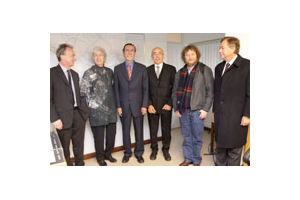
Two years ago, CORFO proposed to enhance the creation of research centers and world-class development in Chile, for it created the Programa de Atracción de Centros de Excelencia Internacional para la Competitividad of Innova Chile. In this process the School of Physics and Mathematical Sciences at U. de Chile has been the protagonist. To date, two international centers have chosen this School as the main ally to develop frontier research in the country.
To the project CSIRO-Chile, an Australian organization which focuses is the solution of complex problems on a large scale, now joins the alliance with INRIA, the French Computer Research Center largest in Europe.
The creation of the INRIA Center, which in Chile will be CIRIC – Communications and Information Research and Innovation Center – aims to train engineers and researchers, creating a new industry that requesting research for the delivery of services in Latin America. The new center will be coordinated by the Universidad de Chile, an institution working in conjunction with some universities such as Pontificia Universidad Católica, Federico Santa María, Adolfo Ibáñez, Católica de Valparaíso, de Valparaíso, Diego Portales, de la Frontera y de Concepción.
INRIA, founded in the sixties, has grown to have 8 regional centers throughout France and more than 3,000 researchers. “Also, it has created more than 100 spin-offs from their projects,” explains José Miguel Piquer, DCC academic, who will be Director of Research and Development (R & D) of this center.
CIRIC officially starts in March 2012 to develop three areas funded by CORFO: Internet and Telecommunications, Hybrid Energy, and Natural Resources Management. Initially, each area will have two projects, a total of six projects; three of them are led by the Universidad de Chile: two by the Center for Mathematical Modeling (CMM) and one by the Department of Computer Science (DCC).
For José Miguel Piquer the arrival of INRIA is a dream come true. “I was the first Chilean to do his PhD at INRIA where arrived in 1987. I immediately fell in love with this institute, about its the atmosphere and how they work. Returning to Chile I was convinced that here we had to do was a similar institute. I never thought 20 years later, we would have the option of opening an INRIA in Chile, associated among us,” he explained.
Enhancing the research at FCFM
To develop CIRIC, the DCC will contribute its Network Research Lab, which depends on NIC Chile (NIC Chile Research Lab). “On the other hand, students at DCC are a fundamental support for developments and projects that the Centre could undertake in the future,” said José Miguel Piquer.
The academic also noted that DCC should be one of the main beneficiaries with the existence of this center, because INRIA’s products are essentially software, so all the knowledge of advanced technologies the DCC has will be crucial to CIRIC. “The Center will create new projects through the time, and our bet is DCC should remain one of the key players toward the future.”
“The scheme is to maintain CIRIC research at universities and funding resources required for the transfer: engineers of development and engineers of new business. The center will have an office for the systematic support to the projects in its transfer’s policies, “explained DCC’s Professor.
For Rodrigo Palma, director of the Center for Energy (CE) at FCFM and Associate Research of the Institute for Complex Engineering Systems (ISCI) and CMM, and who will participate in the Energy Hybrid area, this iniciative is of great importance for the CE, because it will enable the Center to project as it will project its strategic lines of development in the longer term. “Through the CIRIC we can consolidate and focus the efforts on specific issues and with impact on industry and public institutions,” he declared.
Another CIRIC’s line of research is related to omics sciences, which in particular will be developed by the Laboratory of Bioinformatics and Mathematics of the Genome (LBMG) of CMM-CRG and Symbiose and Bamboo Group of INRIA. Alejandro Maass, LBMG’s director, said the interaction with the French researchers began long before the teams were settled for CIRIC. “With Symbiose we have a longstanding relationship, as well as since 2011 we are associate team and we are developing joint research. We have students in co-supervision and in this French group some engineers of my lab have been formed in their Ph.Ds.”
