
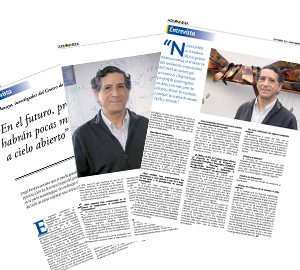
The mathematician engineer and researcher at the Center for Mathematical Modeling (CMM), University of Chile, Jorge Amaya has worked on studies related to underground and open pits mining. In fact, in late 2010 he concluded the project “Complex systems, evolutionary computation and applications to the open pit mining planning”, which its main objective is to determine mineral extraction sequences that generate sustained economic profit growth in the long-term. Today, while he is working in the preparation of the final product of this project, he takes a break from his duties and tells us what is the contribution of mathematics to the mining process?, the key decisions to be taken in an open pit mine and the future of this type of deposit. Amaya also predicts a change in the next 30 to 40 years.
How does the mathematical modeling apply in open pit mining?
The main potential of mathematical modeling is you can objectively express the requirements and decision criteria in the industry in general, but particularly in what we call operational sequences or sequences of extraction, ie the order in which resources are obtained in an open pit mine. Clearly they cannot be removed in any way, in any order, there are a number of conditions that have to do with safety, feasibility and value. For example the pit slope angles are too steep to prevent cave-ins while selecting material of greater value to maximize profit. Or, extracting less valuable material allows the access to the most valuable material. Undoubtedly these are complex decisions. In this respect gives the math objectification correct the problem by writing the equations of the phenomenon.
What are the leading aspects of this objectification?
It has to do with setting the optimization criteria, so there are two essential elements: the objective function or what we want to optimize basically define what we consider the criterion of optimality. In the case of the mining business is common the use of the Valor Actualizado Neto, which values the business in the long run. On the other hand there are restrictions, ie, what things we should meet as requirements.
The calculations that this generates are high demanding. Conventional computers are no longer able to support that process. The execution time is very high, an extraction plan for a large mine may take between 8 and 20 hours or more of the computational process in a conventional PC to finally generate a solution that the user can analyze and / or apply. Appearing high-performance computers, what we call High Performance Computing or HPC as the one we have here at CMM, we are able to calculate these processes more efficiently and faster, this is a huge advantage from the industrial point of view because it allows you to test many scenarios of prices and costs in a relatively short time.
What aspects have evolved in the way of implementing the mathematical modeling?
The mathematical model has found application in the field of mining and has created what I call cross-fertilization between science and technology. In technological processes such as mining, are both scientific and mathematical challenges which induce topics in the area of research. At the same time research generates products applicable to the industry, then, there is a feedback between both of them.
In the last 20 years there has been a growing interaction between mathematics and mining, and the main reason I believe is the emergence of high speed computers, which allow doing what previously could not.
Mining is evolving to the point of being a less traditional science and industrial area has become highly scientific content, in that sense there is a mutual benefit between mathematics and mining.
What mathematical programming techniques are used today?
Basically it uses linear programming and its derivatives. This technique came around the Second World War, focused on military operations, but later with the development of computers has been used so far in what I call the science of decisions. There are complex calculations, for example the exploitation of a mine is not a single decision but a sequence of decisions, millions. Then, work that computationally is very complex and would not be possible without the techniques of linear programming and its derivatives.
What improvements have occurred in the mathematical modeling method for planning and optimization processes of open pit mining?
In our case, the systems we have done at CMM, supported by Fondef Program of CONICYT, are operational at the Institute for Innovation in Mining and Metallurgy (IM2) of Codelco. The benefit is that these methods, which are converted into software, allow generating high value extraction plans, ie increasing the value of a deposit from the strategic point of view. Giving the sequence of operation, an associated value is delivered because it lets you know how much is obtained in a specific given time, ie there are different scenarios that the owner can evaluate, in this sense our major contribution is generating many plans in a short time. In my opinion the strategic planning plays a key role in the business value and not so much in the operation.
It is true, much can be gained in the operation by optimizing various stages of production, transport trucks, on the metal, but the greatest value is in making a good decision on how to operate a mine in the long term .
Describe the process …
We have worked both the open pit and underground case, in collaboration with the IM2. IM2 is which performs the approaching to the final client, in this case the mining, so they have been who applied the different models in Codelco mines. They have studied the sequence of existing mines and were able to re-evaluate as follows the process from here on out, but it is not a consultancy but a more interactive process between those in the methodology and those in the application.
Our action in the market is through an intermediary such as IM2, we still have no end of software products, but rather effective prototypes for use by specialists.
What changes have the open fields experienced due to the lower grade and the introduction of new technologies?
There is a better assessment of the business in the economic point of view, an optimized pattern or sequence extraction allows a mine to project what is its future residual value. In general changes in the mining industry come from the computing and computing capabilities that did not exist. By making all this computational methodology in an effective calculation or of high-performance there is a change because it creates an enormous potential of analysis. Currently, it is very important to be able to high-performance computing, to study various scenarios and parameters such as sensitivity to prices and costs.
Are you approach by mining companies when are designing a pit?
In this issue we have no direct relationship with companies until now. We are mediated by technology intermediaries, such as IM2, so that mining does not ask us for a regular consulting service. In the future is not excluded that such services are performed by software or consulting firms that are at the interface between the generator of technologies scientific based, such as CMM, and mining entrepreneur.
The CMM and Codelco IM2 developed a Fondef project, entitled ''Complex Systems, Evolutionary Computation and Application to Mine Planning,” What is it?
We used calculation methodologies that come from the intuitions of how nature works. So there are born different algorithms that allow us to imitate the optimization of nature, it is what we called evolutionary computation. The project lasted three years and generate mathematical models for planning the pit, computational algorithms, and from that, we designed software that is currently in pre-industrial level in use on IM2. Package that business is the only thing nedded.
In the medium term our desire is to generate remote assistance in the high-performance computing cluster atCMM, so a Chiquicamata mine-worker, for example, can enter to his data and runs the processes online, gets the results and produces the analysis quickly and repeatedly. This work saves resources because it prevents each company buy its own computer cluster, since the service is centralized.
Is this being done with any mining company?
Mainly through the IM2, with which we are negotiating a long term partnership agreement. This would allow future development of technologies for the mining industry, jointly between industry and university. There is already a business plan, its costs and requirements to create this alliance.
What is the balance?
The sequencing software is already installed on IM2 and Codelco and we have provided information that will help us to our final product. I am very optimistic, so we need to package our product, that is, apply the business plan.
What is your projection?
Create a remote service planning assistance.
How do you see the future of open pit mining?
To the extent that resources are depleted surface mining tends to become groundwater, particularly the large mining and probably in the future open pit mining will be aimed at medium-scale mining. The pit cannot be very large, the costs are very high, just think that to remove material from a mine to the surface as Chuquicamata, the truck runs several miles, then the expenditure is large. With the increasingly high cost and resource depletion on the surface, most likely, an open pit mine cannot spread too much, you have to switch to another technology such as underground mining. In terms of time, I mean 30 or 40 years. In future, probably, there are very few large open pit mines.
To view the magazine in Spanish, click here
