
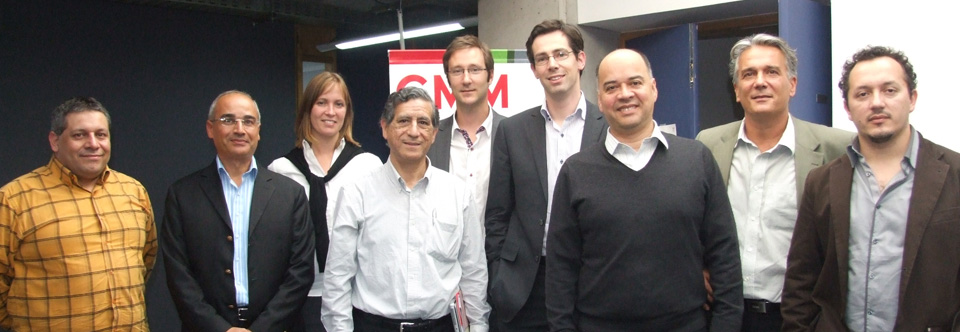
Today more than ever it is necessary to transfer scientific knowledge to industry and public policy, which can only be achieved through effective models of collaboration between universities, business and government. Recognizing this need, the Center for Mathematical Modeling, (CMM), University of Chile, organized a Workshop on Technology Transfer, which aims to explore the trends that have been successful globally for this purpose.
The Center for Mathematical Modeling of the University of Chile is holding a Workshop on Technology Transfer during September 13 and 14th, which central theme is the “Spin Off” aimed to materialize university research into applied innovation for the industry and society.
The activity collects exhibitions of scientists and experts from Belgian universities of Louvain and Mons, invited to show case studies, regulations and procedures that have emerged in developed countries for the implementation of Spin Off business.
This modality allows universities and scientific centers to create a business aimed to convert knowledge into innovative applications for R+ D sector. In simple terms, a spin-off company offers researchers the ability to bring their projects to a self-sustaining enterprise.
While it is a growing trend, the commitment to a Spin Off is long term and will require investment, as explains one of the main speakers of the meeting is Benoît Buntinx, former Business Development Manager of the Office of Technology Transfer University of Louvain in Belgium, now representing the spin-off GreenWatt SA, specializing in the development renewable energy, and which is already operating in Chile on projects related to mining, with Fondef support .
“The most important thing is the quality of research. The University of Chile and the country has both all the quality to get results and transfer them to the market”, says Buntinx.
However, the expert points out that there are basic conditions for an university’s technology transfer office to succeed. It must have a clear mission, autonomy and sufficient human and financial resources: “It’s a long-term bet, five to ten years, in which we must invest in research. Probably just one of every five spin off generated may succeed, and it has to be able to financially afford another four”, he says.
Transfering projects in Chile
The promoter of this Workshop is the CMM mathematician Jorge Amaya. He explains that this initiative “aims to explore the trends and successful cases of technology transfer that allowed the participation of researchers, companies and the state in the process of innovation and development “.
In this occasion, will also be exposed eight case studies of investigations borne at the Faculty of Physical and Mathematical Sciences and which have resulted or are in the process of becoming products and services for industrial sectors such as transport, energy, mining, fishing and wine.
One of these cases is the “Osiris Project”, supported by an european business consortium with public and private funds, is creating a model to streamline the flow of energy consumption and on subways trains of Milan, Rome, Paris and Istanbul, and significantly reduce the temperature in the passenger environments.
Also in the energy sector, the “Huatacondo Microgrid Project” generated a computational tool that allows people Huatacondo community, located in northern Chile, perform network management in its power supply, maintenance, monitoring and making consumption decisions in the context of a sustainable model.
In the fisheries sector, meanwhile, the project Sustainable Recovery Hake, supported by the Regional Government of Valparaiso, searches through mathematical models to suggest strategies for this resource recovery, after was strongly affected by overexploitation in the past decade.
The Workshop ended Friday 14th. The program is available at wtt2012.cmm.uchile.cl
