
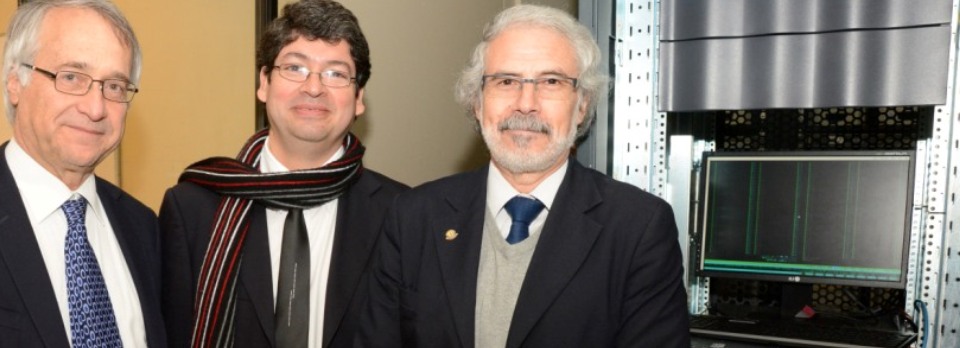
- In the Universidad de la Frontera opened the first regional node supercomputing for scientific data processing and mathematical modeling. It is capable to perform molecular modeling, bioinformatics data processing and analysis of real-time weather signals, among other applications.
The Universidad de la Frontera (UFRO) began operating a new high performance computing equipment with scientific capability. It installation is part of the National Laboratory for High Performance Computing (NLHPC) project leaded by the Center for Mathematical Modeling of the University of Chile, with support and funding from the Associative Investigation Program (PIA) of CONICYT.
This is the first regional node, which adds to the central cluster of High Performance Computing installed at the Center for Mathematical Modeling (CMM), Faculty of Physics and Mathematics of the U. of Chile, which will reach about 3000 cores this year. Both are connected via REUNA with different national scientific and academic centers.
This new breakthrough in NLHPC project has great importance to meet the needs of scientific research in Chile, where a huge amount of data is been generated, and it is expected produce new shared knowledge from this data. Therefore, it is essential to have advanced computing capability in local areas – because few years ago should be sought abroad-, along with a connectivity infrastructure for sharing and collaborating with new knowledge.
The node was opened on April 18 at the Center for Modeling and Scientific Computing UFRO, with the presence of NLHPC Project Director, Eduardo Vera, who said that “All areas of the task are using tsunami data. Therefore, the management of this information requires these capabilities and the consolidation of a national high-performance infrastructure to meet the demand for scientific computing that can be used in all areas, such as medicine and agriculture”.
Similarly, Andres Avila, UFRO representative in this project, highlighted the benefits of such equipment in the Araucania Region: “As a university, we opted for a shared memory system, which allows complex problems to run fast. We will be part of a national network, wich enables the access of the rest of the country to do experiments”, he said.
Applications
The computer Cluster Altix UV2000 has 12 Intel 8-core Sandy Bridge each and 192 GB RAM shared memory. It can develop mathematical modeling of high performance in areas such as molecular modeling, bioinformatics, industrial design, data mining, astrophysics and real-time processing of meteorology signals.
“We are making meteorological forecasts and sending it to local farmers for a year, adjusting the model of Meteorological Direction of Chile with local weather stations, obtained under D06I1100 Fondef project, so we have a better prognosis calibrated for the region. We speak of rainfall and wind speed, which requires a greater amount of processing to deliver temperature forecasts every hour”, said Dr. Avila.
About NLHPC Project
The National Laboratory for High Performance Computing or NLHPC aims to install in Chile a capacity of high performance computing, able to respond the local demand of processing data from basic and applied scientific research, as well as industrial applications. This project is driven by the Asociative Research Program (IAP) of CONICYT and led by the Center for Mathematical Modeling (CMM) of the University of Chile, into a collaborative model with REUNA, which allows the interconnection of this infrastructure with the main scientific and academic centers of the country, through a high-capacity network.
This open collaborative project also involves the partnership of Universidad de la Frontera (UFRO), Pontificia Universidad Católica de Chile (PUC), Universidad Federico Santa María (UTFSM) , Universidad de Santiago, Universidad de Talca y Universidad Católica del Norte.
[alpine-phototile-for-flickr src=”set” uid=”89937484@N08″ sid=”72157633317366621″ imgl=”fancybox” size=”240″ style=”floor” row=”4″ num=”30″ align=”center” max=”100″ nocredit=”1″]