
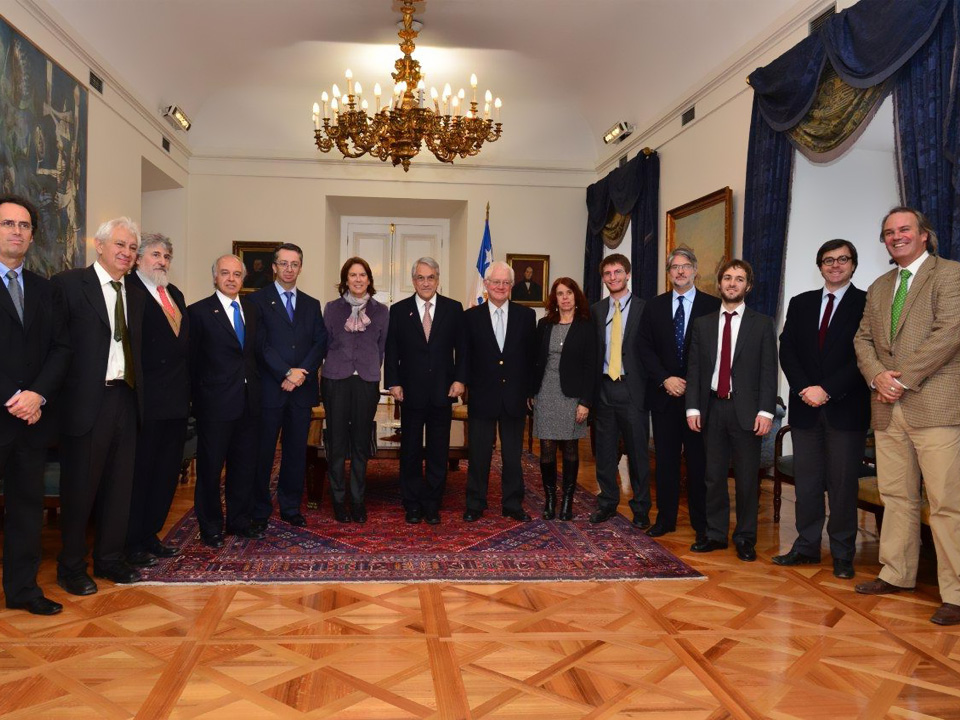
- CMM researcher integrate Presidential Advisory Commission which delivered a report aimed to modernize the institutions framework of science, technology and innovation in Chile. “We chose to favor the formation of human capital” he stressed.
The Advisory Commission convened by the President in January to develop a proposal to modernize the institutions of science, technology and innovation, presented the report containing the conclusions from this instance.
The commission was composed of 14 experts, including the National Award for Science, Servet Martínez, researcher at the Center for Mathematical Modeling and renowned professor of the Faculty of Physical Sciences and Mathematics, University of Chile.
The academic explained the centerpiece of the proposal suggest the creation of a new ministry with two undersecretaries: Higher Education and Science, Technology and Innovation.”If you look close, these two issues put together means we’re favoring universities developed in the light of new ideas and challenges, as well as science and technology must collect human capital from higher education, form it, inflate it with ideas”, he says .
About the work of the Advisory Commission, Servet Martínez stresses that many different views of the members were able to converge on a common purpose and come up with a solution able to set Chile in a better position to address the challenges of scientific and technological development, which at the same time, was the most feasible and appropriate for the country’s institutional framework.
“We chose to favor the formation of human capital. The country needs to take a significant leap in education, in particular, have a competitive higher education. That is the guarantee that we will address scientific challenges, technology and innovation”, he said.
The proposal:
The report shows an analysis of the current situation and warns a dispersed and fragmented institutional framework, lacking a structure that leads to a coherent decision-making, consistent with a good use of public and private resources. It highlights the lack of coordination between institutions and agencies related to science, to the formation of advanced human capital and improving the productivity of the economy.
Among the proposals, suggest the creation of a new ministry directly assume the design of policies and development of science, technology and innovation, including higher education.
The report emphasizes that quality higher education should be constantly permeated with research in science, arts, humanities, technology and innovation.
The Advisory Commission noted that this proposal constitutes a recommendation to which is due to start moving. Its implementation must be carried out at a reasonable pace, having to invite the main actors involved in the process to a further discussion on specific measures that can be implemented at various stages.
Members:
The commission was presided by Bruno Philippi, and composed of Hernán Cheyre, Mariana Aylwin, José Miguel Benavente, Fernando Claro, Juan Carlos de la Llera, Oscar William Garreto’n, Vivian Heyl, Sergio Hojman, Fernando Le Fort, Servet Martínez, Juan Manuel Santa Cruz, Bernabé Santelices and Ricardo Solari.

