
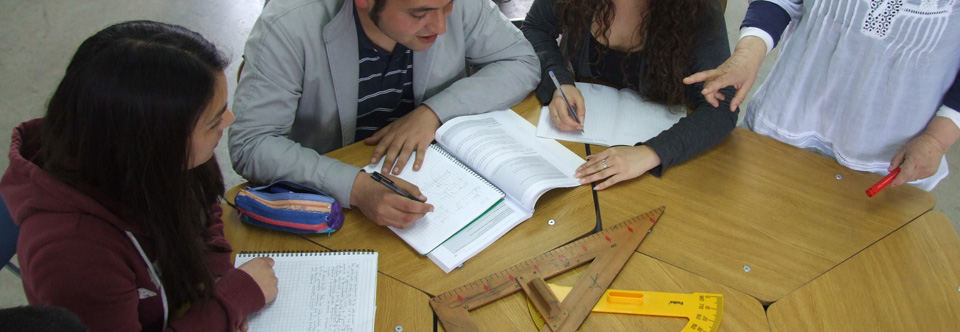
In front of an audience that included teachers and directors of different schools from the Región Metropolitana, the CMM Education Lab of the Center for Mathematical Modeling (CMM) presented its programs which seek to improve the teaching and learning processes mathematics in school: the Post Graduate Diploma in Mathematics Teaching and the Problem Solving Workshop as well as other courses and seminaries.
“The objective of this meeting is showing the projects of the CMM-E to the teachers and explaining them how our research has produced tools for the professional development of teachers both Elementary and Secondary Education. So, we are transferring knowledge generated by the research to this target group of users”, explained Salomé Martínez, Education Lab director.
“Actually, the programs offered by CMM are so comprehensive. I would like to know how the approach to a freer Mathematics teaching is and how to use the resources of the imagination. As CMM’s professors said here, how to create situations based in more in abilities than in content learned memorized by a student” said Paola Quintanilla, teacher at Lincoln International Academy.
Post Graduate Diploma in Mathematics Teaching
This is the first Chilean post graduate program aimed at professionals who participate on the initial and continuing training of the Elementary teachers as well as the leaders of the Math areas in schools.
“The idea of this Diploma is analyzing the crucial issues of teaching school mathematics in deep”, said Martínez.
Integrating mathematical and pedagogical knowledge, the program deeps in the fundamental curriculum axis: ‘Facts and Random’, ‘Numbers’, ‘Algebra’ and Geometry and Mensuration. It also addresses issues such as case study, problem solving and classes analysis.
Problem Solving Workshop
Solving math problems is a crucial ability for the Chilean curricular bases of the Secretary of Education. This workshop is an opportunity for the teachers to ‘do Maths’, solving problems with support of a instructor, in order to make them to think about their own capacity and role in the classroom.
“I think these programs approaches not only to the didactic portion of the class, but also to the contents and the methods we use, where schools usually fail” said Luis Romero, Colegio San Agustín de Santiago’s principal.
