
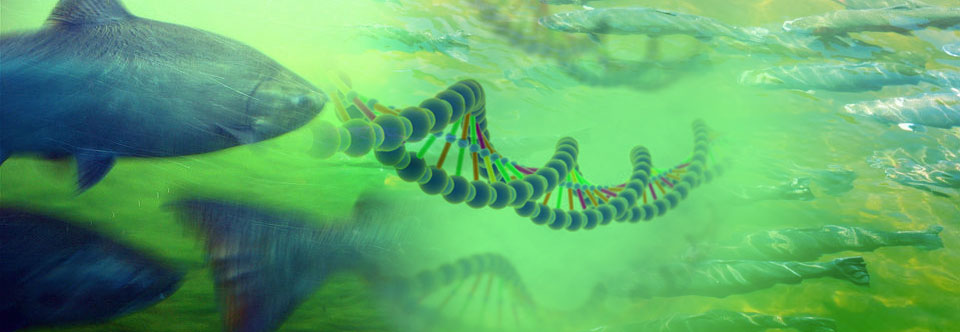
The genome sequence of the Atlantic salmon has successfully been mapped. This achievement, which provides information about one of the more complex genomes due to its duplication, has been made by a team of Canadian, Norwegian and Chilean scientists, together with researchers of the Center for Mathematical Modeling (CMM) of Universidad de Chile.
The study was launched by the International Cooperation to Sequence the Atlantic Salmon Genome. The Chilean Scientific Committee, which Professor Alejandro Mass was a member of, had the role to be the scientific advisor of Corfo. He, along with Patricia Iturra (Universidad de Chile) and Rodrigo Vidal (Universidad de Santiago), participated in the design of the project implementation as well as made a crucial contribution in the area of bioinformatics.
After a first phase in which 30% of the metrics was reached, the strategies developed by the Scientific Committee were checked in order to determinate the genome assembly. In this second phase —tendered to the J. Craig Venter Institute in Maryland (USA)— many tasks to assess the strategy were implemented. The engineer Alex di Genova from the Laboratory of Bioinformatics and Mathematics of the Genome (LBMG) of CMM implemented the All-Paths assembler method. “We have gained significant experience through previous complex genomes assemblies such as the Sultana grape, which allowed us to do unpublished research”, pointed out Maass. Indeed, CMM has been conducting genome projects since 2003, when bacterias in biomining were studied.
Masurca software, created by the Department of Mathematics of University of Maryland, played a major role in the last phase. It can assemble data sets containing only short reads from Illumina sequencing or a mixture of short reads and long reads. Masurca combines complex genome assemblies with new ideas from symbolic dynamics. Since this method allowed reaching 95% of the metrics, the salmon genome sequencing was resolved.
These results open a wide variety of possibilities. They are not only a milestone for the scientific community but also a benefit for the fisheries and aquaculture industry industries. This new knowledge can lead to study key problems such as disease resistance, nutrition and genetic improvement, which can bring relevant breakthroughs.
