
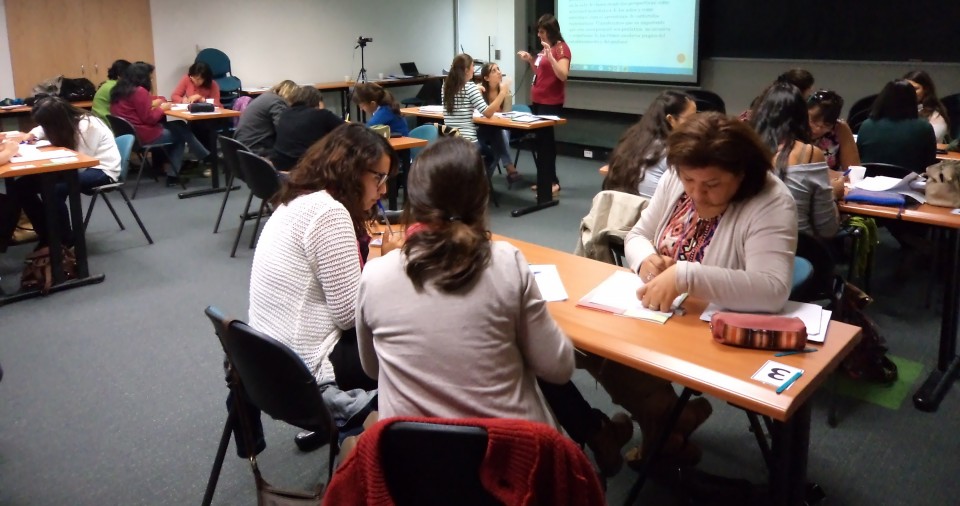
As a response to the demands arising in the last changes of primary and secondary education curriculums, two researchers at the Center of Mathematical Modeling (CMM), Patricio Felmer and Josefa Perdomo, presented the results of a study that examines how novice teachers approach solving problems and which strategies they used.
The changes in the curriculums, which have already entried into force in 2012 in primary education and they will do so in 2015 in secondary schools, emphasize on skills such as modeling, representing, communicating and reasoning, as well as solving problems.
“We wanted to create a space to inform about our project results and to debate with the attendees the importance of solving problems. The aim was to exchange ideas about the skills required in the new curriculum and how teachers can make students to learn them”, pointed out the National Award for Science.

The event, held on August 4th 2014 at CMM, brought together academics and heads in Pedagogy on mathematics education careers from the Pontificia Universidad Católica de Valparaíso, Universidad Metropolitana de Ciencias de la Educación and Universidad de Chile. Indeed, Felmer and Perdomo’s research collected data on teachers graduated from these three institutions with less than four years of working experience. Thus, teachers were observed while conducting three classes and they were given the task to solve two math problems with more than one possible result.
Felmer highlighted that many of the teacher involved in this research showed “a limited familiarity” with solving problems, since they could not find out the multiplicity of results in the response, for instance. In his opinion, this can be due to the fact that academic programs do not contemplate these kinds of abilities for training teachers, which “universities should include”.
“There is not a culture of solving problem sat universities, where memorizing but not proving is key. And teachers use the same methods in the classroom. So, mathematics become a repetitive act”, said Isabel Vargas Calvert, an academic from UMCE.
Similar opinions were shared by other attendees as Camilo Quezada, lecturer at the Faculty of Science of the University of Chile. He considered that the most valuable aspect of problem solving is its utility, for instance, to achieve life skills.
After this first phase of data collection and preliminary analysis, Felmer and Perdomo will continue analyzing the information in order to come to the conclusions of this project, whose framework is the Fund and Development Program for Education (Fonide), within Ministry of Education.
