
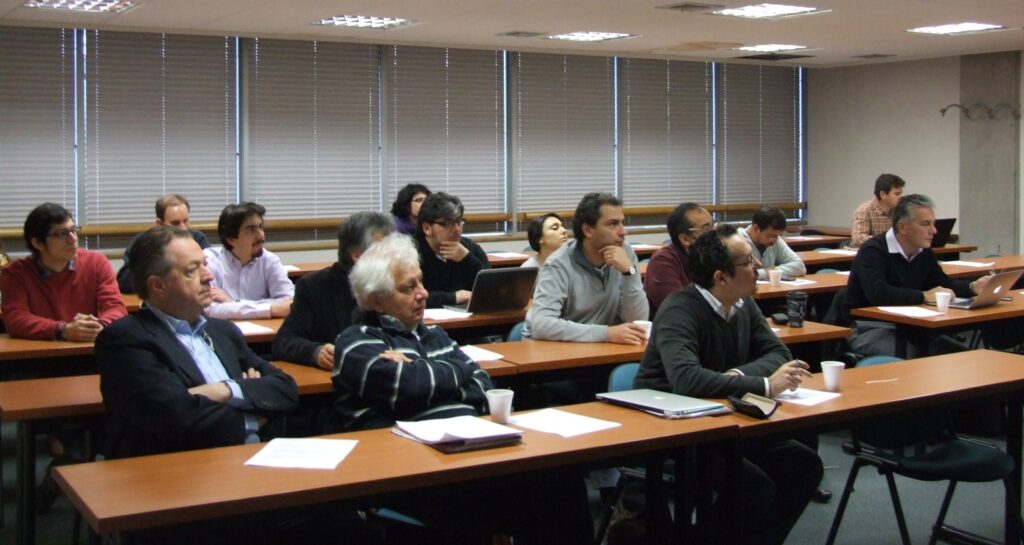
The Center for Mathematical Modeling (CMM) hosted on 10th September 2014 a new Ciric- Inria Chile scientific meeting that gave the opportunity to four researchers to present their projects, all of them aimed to be translated into technology transfer. Indeed, Ciric is a center established by the French institute Inria and dedicated to innovation in the field of information and technology transfer.
“In this third meeting, we could see high level projects with many progresses already made. These researches have a great potential for application “, highlighted Héctor Ramírez, researcher at CMM and member of INRIA-Chile.
The meeting was opened by Philippe Bordron, researcher at CMM, with the project “Deciphering respective genome wide roles of bacteria within a community responsible for copper bioleaching metabolic processes: an integrative systems ecology approach”.
Bioleaching is a process where the microorganisms extract red metal from low grade sulphide ores. This project is a new ecological approach of systems that aim to give a functional sense to a metagenomic consortium through integrating genomic and metabolic knowledge.
The second talk was given by Rolando Rebolledo, lecturer at Pontificia Universidad Católica de Chile, and was called “Towards the construction of a virtual oscillating water column”. This project intends to calculate the energy production produced by the device known as Oscilating Water Column, which uses marine energy. It estimates the energy based on mathematical models that simulate the interaction of waves with this devide.
Fabio Carrera, PhD student at Pontificia Universidad Católica de Valparaíso, presented also his project,”Integrated Methodology for predicting the generation and dispersions of odors: Application to the sector of a treatment of wasterwater plants”. He showed integrative models for odoriferous compounds generation and winds simulations in order to avoid odors production in wastewater plants. The relevance of this research relies on the fact that odor management in Chile is a problem with a nationwide strategy still to be defined.
The event ended with the talk titled “Viewing and Applications of Graphs”, carried out by the researcher from Universidad Técnica Federico Santa María,Reinaldo Vallejos. He presented a software which is capable to efficiently visualize large graphs, which are measured on scales of million of nodes. It is important to consider that software nowadays only visualizes on scales of thousands of nodes.
Inria-Chile was established in partnership with nine universities in Chile, among them the University of Chile, which has the largest participation in this institution. It works with researchers in Chile and France, and seeks to be a strategic innovation partner for the Chilean industry. Three members of CMM are in charge of leading research areas of Inria-Chile: Alejandro Jofré, Alejandro Maass and Héctor Ramírez, who are directors of the project-teams Energy Optimization and Control, Omic Sciences and Bioprocesses and Natural Resources Management, respectively.
