
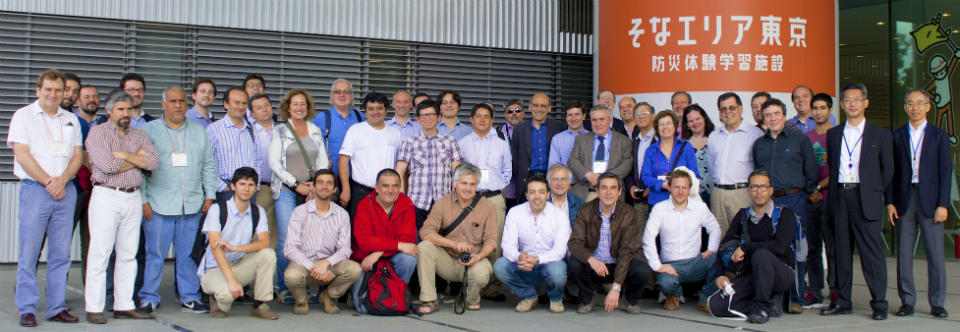
Five researchers from the Center for Mathematical Modeling (CMM) joined the Chile-Japan Academic Forum 2014 held at the University of Tokyo from October 6th to 9th for the first time. CMM director Alejandro Jofré as well as researchers Vicente Acuña, Jorge Amaya, Francisco Förster, and Eduardo Vera were part of the extensive academic delegation that traveled to Japan for this purpose. Faculty of Physical and Mathematical Sciences Dean Patricio Aceituno and senior researchers from the Faculties of Medicine, Sciences, and Economic and Business formed part of the delegation’s main group, twentyeight researchers of the Universidad de Chile led by university’s president Ennio Vivaldi. Conycit president Francisco Brieva and twelve researchers from Universidad Católica were among the other Chilean participants.
Everyone had the opportunity to discuss and share knowledge on Information and Communications Technology (ICT), Big Data, Astronomy, Mining, Metallurgy, Chemistry, Biology, Bioengineering, Seismology and Natural Disasters, Sustainability and Urban Development.
“In most of these areas, Universidad de Chile has an active collaboration with the University of Tokyo,” explains Eduardo Vera, CMM researcher and one of the key organizers of this meeting. “Today, Asia plays an increasingly prominent role in the world. China grows faster than other countries in the region but Japan still has the most sophisticated science and technology infrastructure. Actually, in some fields, the Japanese scientists are clear global leaders, like last week’s Nobel Laureates in Physics. For this reason, it is absolutely strategic for Universidad de Chile to strengthen the academic interaction with the region and the best partner choice is the University of Tokyo, the top university of Asia according to QS ranking.”
ICT/Big Data Workshop
CMM researchers played a leading role in the ICT/Big Data Workshop, where they addressed issues about the future of the massive data processing using mathematical modeling in areas such as Astronomy, Mining, Biomedicine, Industry, and Communications. This workshop was the 8th AccessNova Forum, the semiannual symposium that reviews the progress achieved in the collaboration frame begun by the Universidad de Chile and Nippon Telegraph and Telephone Corporation (NTT) back in 1994, to jointly develop advanced applications for high-speed communication platforms in Chile and South America.
In this context, Alejandro Jofré and Jorge Amaya spoke about real-time mining and the possibilities to prevent disasters using sensors in trucks, miners clothes, machines and other devices in permanent movement in the mine sites. Former student Mauricio Contreras showed the latest progress of the Intel Award-winning smart jacket for miners carried on by SoluNova Ltda., a Universidad de Chile spin-off focused in sensor systems and wearable technologies for environmental monitoring and personal safety in industrial operations.
Meanwhile, Eduardo Vera chaired the session on Advanced ICT for Biomedicine, where the new possibilities in telemedicine, e-health and image processing were analyzed by acdemics from Universidad de Chile and Japanese experts from academia and industry.
Francisco Förster chaired the session on Advanced ICT for Astronomy that addressed the use of frontier mathematical and computational tools to handle big data in Astronomy.
