
“Another example of a project, where the University is actively participating in various discussion tables interacting with several ministries, is the national photonic network and the digital depository of public data, led by the Center for Mathematical Modeling (CMM), which will change the technological potential of the country”.
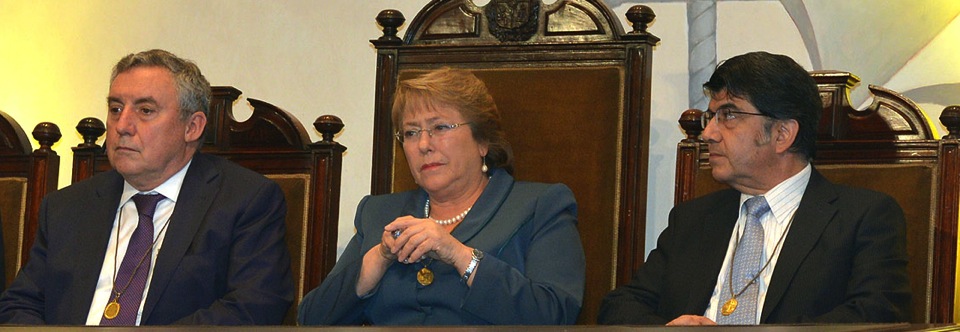
With these words, the President of Universidad de Chile, Dr. Ennio Vivaldi, stressed the role of CMM in the establishment of the fastest data network infrastructure for science and education throughout the country. He mentioned this fact during his first anniversary speech of the University that celebrates 172 years. The ceremony was attended by the President of Chile Michelle Bachelet.
The national photonic network will allow our main scientific centers to share massive amounts of data and to significantly enhance their collaborative research. The network will be built with optical switching nodes interconnected by fiber optic pairs, eventually linking Arica and Punta Arenas with capacities of up to 10 Tbps. This speed would allow transferring two thousand HD movies per second. The first stages of the project will link Puerto Montt-Magallanes and Santiago-La Serena.
“The Ministry of Internal Affairs has established several discussion tables, where CMM is interacting with other ministries and state organizations,” explains Eduardo Vera, executive manager for innovation at CMM and member of these discussions tables. “With a national photonic network, the entire country will have remote access to the computing power of the National Laboratory of High Performance Computing (NLHPC) and, consequently, to the analysis capacities of CMM”.
At present, a fully optical network of up to 320 Gbps has been implemented by NLHPC through Reuna in the Santiago Metropolitan area while, to the north, there is a 10 Gbps link in operation. Using this infrastructure, for example, CMM Astroinformatics Laboratory was able to detect 12 supernovas in March 2014, streaming in real-time photographs of a space 15 times bigger than the size of the Moon from La Serena to Santiago. With theses pictures, thousand of astronomy centers had the possibility to analyze the data of the dying stars detected.
“What CMM did in real-time astronomy, you can do it in other scientific and technological activities, such as mining, biomedicine, seismology, etc. With this scientific milestone, we show the government what a photonic network can do in fields such as e-education and e-health. For that reason, the outreach of our current work is of critical importance,” concluded Vera.
Photo: Fotopresidencia.cl
