
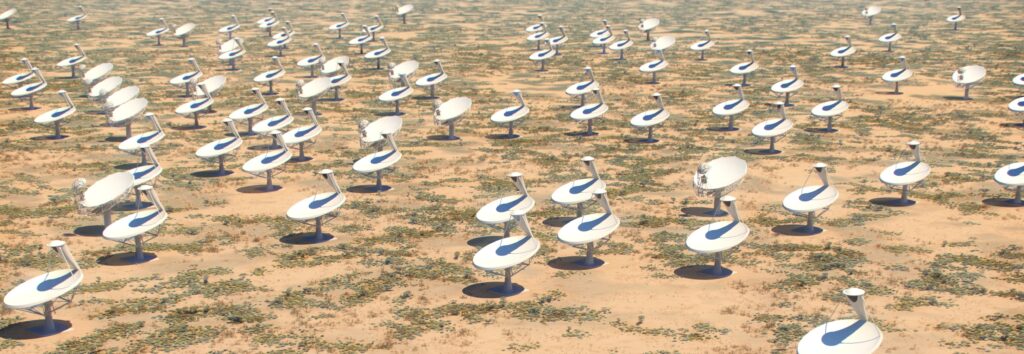
It is not the first time of Juande Santander-Vela in Chile. He worked in European Southern Observatory, which is in charge of Alma, for many years in the past and, now, is a system engineer of one of the most ambitious projects in Astronomy: the Square Kilometre Array (SKA), which will be the largest telescope in the World. On December 10th, he was in the country again to lecture a conference at Center for Mathematical Modeling of Universidad de Chile (CMM). In the talk he presented the project for the first time in Chile and discussed with the audience about the tasks implied in a huge project like this as well as the challenges and opportunities for the Astronomy.
History
The SKA project groups 11 countries: Australia, Canada, China, Germany, India, Italy, New Zealand, South Africa, Sweden, the Netherlands and the United Kingdom. However, the telescope itself will be placed between Australia and South Africa, countries with adequate weather for observation but separated by the Indian Ocean. From this fact come some difficulties in its building and operation.
The SKA has two main scientific goals. On the one hand, it will study elemental forces and particles, which involves subjects like gravity and magnetism. In the other hand, it will research on the origin of the galaxies, universe, stars, planet and life. To address these issues, the consortium is organized in groups that have generated 13 programs to study topics such as astrobiology, galaxy evolution, cosmic magnetism, cosmology, cosmic dawn, pulsars, transients, and the eldest particle of hydrogen in the universe.
These programs demand high technology solutions for different and new problems.
“If you see all the challenges SKA must solve, many of these future solutions could solve problems in Chile. For example, we must build a distributed very high-speed communication network. This could be useful to generate a sensor network you can use to feed in the future a national system of early alerts for earthquakes in Chile,” exemplifies Santander-Vela.
Eduardo Vera, NLHPC director and member of Astroinformatics Laboratory, results of these challenges are unpredictable, but will bring benefits to science: “Certainly, it is a science frontier project in information technology, addressing all the exascale computing challenges. With the visit of Juande, we have an ear and a position in a table where we can share knowledge, which we can use in the future. This knowledge could be surprising. In the path of the science, you can find many applications you never have thought about it or imagined it, but solve different problems. This project is an opportunity to generate new knowledge and you must not be a wizard to understand it is very valuable.”
An important technical challenge is the antennas installation. This demands coordination to build different kind of antennas according to the needs of observation and the weather conditions of two different countries separated by an ocean. The solution was in installing higher frequency antennas in Africa while lower ones are in Oceania.
“I have been thinking about the magnitude of the project and the infrastructure and computing challenges involved. As the radiowaves are longer than other waves, you need largest area for this SKA. Hundred of kilometers separates one antenna from the other, and all of them must be synchronized to study variations in the light phases between one and other antenna,” says CMM scientist Francisco Förster. “It opens a new windows, such as Alma did it in a moment. In this case, it is a windows to radio observations in larger distances and shorter scales”.
Also, challenges in data transmission, processing and saving exist.
“From a the point of view of the supercomputing, it is the first time I hear about zettabytes. It is a challenge to save that amount of data. In fact, the lecturer thinks they couldn’t save this information forever. Only for 10 years. And they don’t know what technology they apply to save that data! It is very interesting they have to address this challenge for the world of computing progresses,” explains Ginés Guerrero, NLHPC’s technology manager.
