
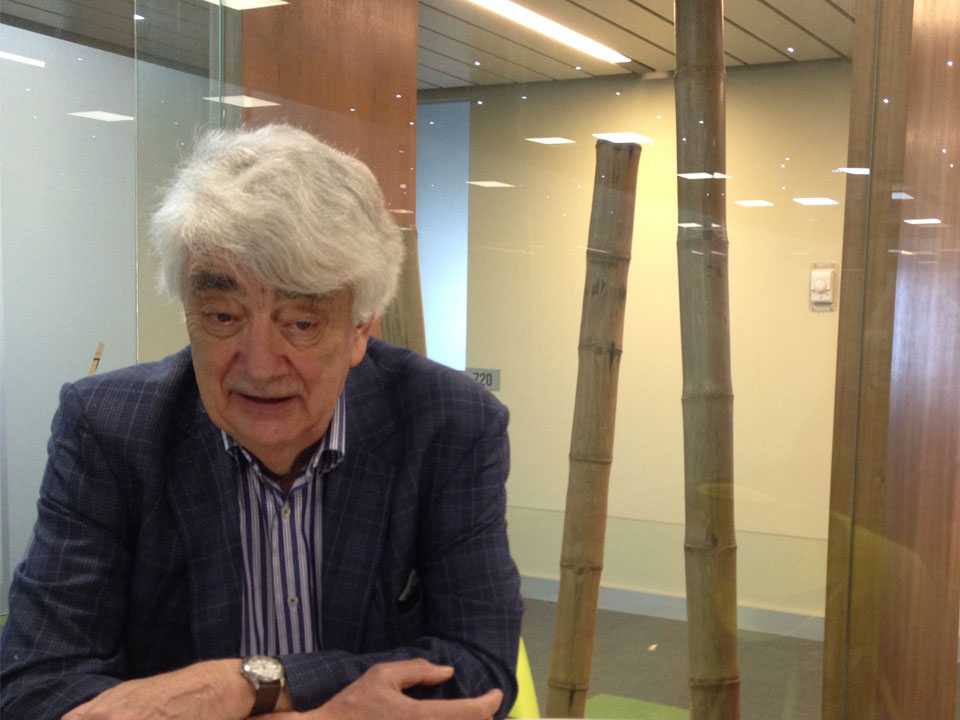
For many experts, he is the father of the current generation of prominent French economists, where Nobel Prize 2014 in Economic Sciences Jean Tirole and author of The Capital in the XXI Century Thomas Piketty shine. Roger Guesnerie arrived in Chile to join in the Optimization meets General equilibrium theory, dynamic contract and finance Workshop organized by the Center for Mathematical Modeling of Universidad de Chile (CMM), which was attended by a group of leader researchers from Europe, United Stated and Latin America, to debate about last mathematical advances in different areas of the Economy.
Guesnerie is professor at College de France and Ecole d’Economie in France. He also lectured at London School of Economics, Harvard University, University of Pennsylvania and other universities, where he stayed for less time.
He researches in areas such as Public Applied Economy, Public Policy, Redistribution, Climatic Change Economy, Incentives and Contracts, Rational Expectations, General Equilibrium, and Endogenous Fluctuations.
“Last years, I have been focused on Coordination of Expectations, which analyzes what people expect from the future based on the current expectations, using economic models. Some difficulties exist respect to how the people are coordinated. Economic models depend on what people do in the real world, what they address in the short-term and the image they have about the future. We understand the future though our expectations and the coordination of these expectations,” explains Guesnerie.
The economist have joined in the debate about climatic change, analyzing how the Economy can help to revert these phenomena’s consequences as well as its consequences for markets and industries: “We have to pay a price, we cannot think a planetary policy for free. No carbon technology has benefits, but there are costs of implementing climatic policies. Tax policies on carbon use, ecologic policies, rules, and innovation are needed.”
In his opinion, Chile has an opportunity to not contribute to the climate change. Particularly, because of its options in hydroelectricity, despite the ecologists’ opposition: “Different ecologists have different objectives. Hydroelectricity have negative aspects in the environment, but they also are very positives in other aspects”.
Inequality is other issue addressed by Guesnerie. He was part of a commission directed by Nobel Prize 2011 Joseph Stiglitz and convened by former French President Nicolas Sarkozy to analyze the limits of the GBP as indicator of social progress and to propose new ways of measuring the economic development. Today, Guesnerie thinks that inequality has two dimensions. One is at domestic level of the countries, where inequality between citizens grows with the economic growth. The other is in a global level, between different nations.
“There are connections between globalization and inequality. If you create a global market for goods, you are creating a global market for labor, too, in some degree. The question is how the global market of goods affects the global market for labor,” points out Guesnerie.
