
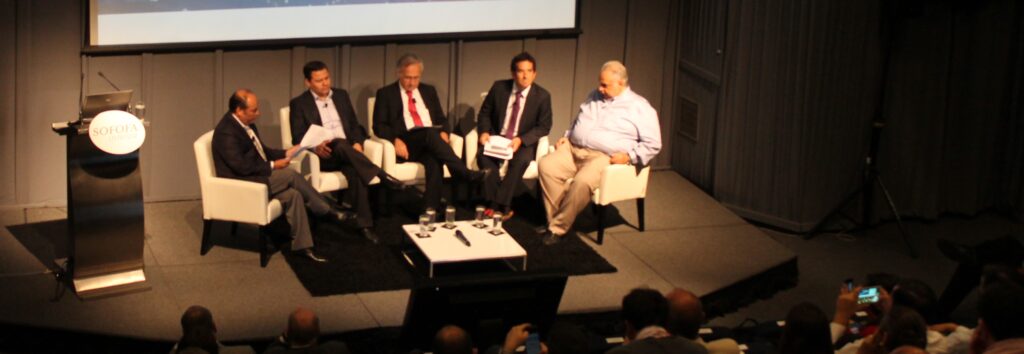
Sharing stage with the Minister of Economy, Luis Felipe Céspedes, the Italian researcher Fernando Liello and other experts, Eduardo Vera, Chief Innovation Officer of the Center for Mathematical Modeling (CMM) of Universidad de Chile, talked to an audience of more of 200 people that was mainly composed of businessmen and managers of companies within the seminar ‘Big Data=Big Business?’.
The event addressed the challenges that using big data will bring for the industry, the academy and the government.
“The relation between the scientific-academic world and the commercial-entrepreneurship world is highly weak. We make good science, but we have weakness when it comes to transfer research to markets and the industry. It is actually the development dynamic of countries that have reached better income levels and life quality better”, stress Vera. “Big data is a great opportunity to change this situation”.
The CMM academic started his presentation speaking about the steps made by the academy in the creation of ties between the different universities and research centers. In this sense, he highlighted the work of the National Laboratory of High Performance Computing (NLHPC), which grew from the seven initial organizations to the 17 in the present: “The creation of the laboratory forced finally to the Universidad Católica and the Universidad de Chile to be in the same connectivity network”.
“We have succeeded in having a share structure, at least at an academic level”, he stated while showing that, nowadays, more than the half of the users of the NLHPC are external to the Universidad de Chile.
Vera took a close look at the opportunities of this capacity of High Performance Computing (HPC) brings to the mining industry, biomedicine and other areas.
“The structural projects of Codelco, which are equivalent to 24 billions of dollars, require modeling and capacities of high performance to plan detailed studies about how to make feasible that enormous investment. Chuquicamata will go to an underground mine and Teniente will be thousand meters under the mountain”, said Vera, who also explained the mining project in real time between CMM and Codelco that will allow to transmit data almost instantaneously about the risk conditions and work in mines to operators and managers: “This is a great challenge for the academy, the industry and the government”.
Thus, he linked the contribution that the HPC can make in mining with the concept of smart cities, which seeks for an urban development more efficient and sustainable thanks to the technology: “We have the opportunity to make a pilot for smart mining, which is less complex that a city, but it implies to optimize the use of energy, transport and mining operation. It means that processes are not optimized sequentially, but connectedly. It requires to register data that are simulated and that appear almost instantly to the supervisor of the world in a way of recommendations”.
He also addressed the challenges of the connectivity for the HPC and big data. “It is crucial to have a national photonic network, because the volume of data that will be transmit in the future are petabytes. There is no account of communication enterprise that supports this. And it makes to focus on use of dark fiber -a network completely optical and of high speed-for the use of big data that have the academy, the government and the industry”.
“If big data strengthens and is used in a massive way for the government and the industry, there is no capacity of performance in Beauchef. Indeed, we would consume the electricity of West Santiago, if we have to do it. And that is not the idea”, he added. “As we have already progressed with the connectivity, it is necessary to have the right conditions to install a cluster that is useful for the country, a technology data center park, in the south of Chile, where there is a lot of energy. It was supposed to be produced there for the consumption in Santiago. Actually the aim is to use that energy in the south and to have the access by dark fiber to that region”.
