
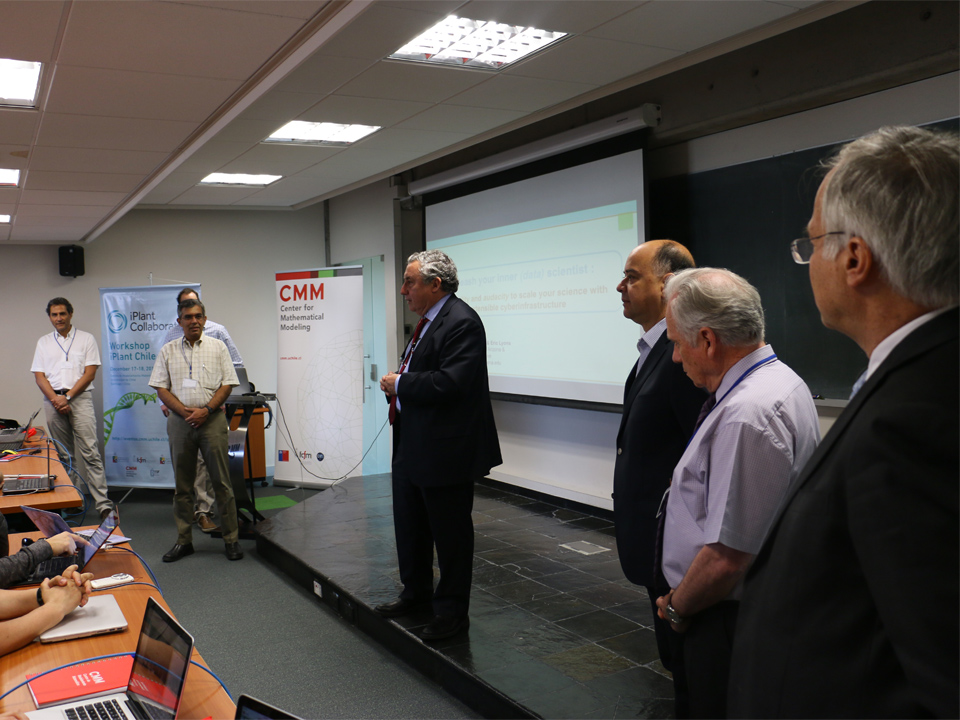
With the attendance of the Universidad de Chile president Ennio Vivaldi in the opening along with academics, PhD students and postdocs from the faculties of Science, Agronomy, Agricultural and Veterinary Sciences, Medicine and Physical and Mathematical Sciences, INTA, as well as Center for Mathematical Modeling (CMM) researchers, the first iPlant workshop was held in Chile.
“This activity is extremely important because fits with this CMM’s enlightened vision to play a pivotal role as a hub for multiple areas of science in Chile,” said Vivaldi.
For CMM researcher Alejandro Maass, who organized this event with Herman Silva and Roberto Neira, academics at Faculty of Agronomy, “with iPlant, Chile will count with a platform that democratizes the biological data exploration and analysis.”
iPlant is a platform that will enable biologists, physicians, agronomists and other life science professionals to process their information in intermediate stages, generating scans without relying on the presence of a specialist in computer sciences just for complex processes and developments.
During the workshop, Nirav Merchant and Eric Lyons, principal researchers at iPlant United States, explained the philosophy of the project and the services they provide to the scientific community. Attendees were also able to perform practical tests on the products offered by the initiative.
“The vision of iPlant Collaborative is enabling life science researchers and educators to use and extend iPlant’s foundational cyberinfrastructure to understand and ultimately predict the complexity of biological systems and their dynamic nature under various environmental conditions,” said Lyons, who defined the concept of cyberinfrastructure as data storage, software, high performance computing and the people organized as systems that solve problems of dimensions that could not be solved without these elements.
Merchant highlighted the possibilities open for collaboration among different scientific: “iPlant is a virtual collaborative organization that enables those who have data to be linked with those who can process that data and vice versa. So it allows to do science allows those who have analysis models and to draw conclusions to those who have information.”
In that sense, Maass notes that the design of the platform assumes all the problems users have in the information analysis. He emphasizes the platform architecture, data management, low difficulty of learning command lines and, above all, access to calculation: “It has been thought, even optimized, for users can access correctly to high performance computing from the iPlant’s tools. And that is something important for us because, with the National Laboratory of High Performance Computing (NLHPC) at CMM, it encourages the use of a tool that is already in Chile.”
Implementing iPlant in the country is the challenge now is to: the options range from implementing all the tools offered by the platform in Chile to generate a well-connected structure with iPlant United States. Always considering the connection to the NLHPC as a key.
This could have an impact even in the way University teaches, explained the mathematician, by opening new possibilities: “It will allow also order the bioinformatics topics in teaching. When things are so well structured from the data, you can do much better courses for applicators.”
