
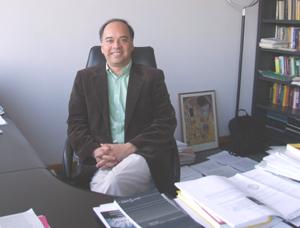
His participation in the construction of investment models and operation planning for the electric industry, his knowledge of the Chilean and international energy market, and training in engineering and applied mathematics were, in the opinion of Prof. Alejandro Jofré, the elements that allowed his incorporation into the Presidential Commission on Nucleo-Electricity, also called Zanelli Commission.
The main objective of this group of experts was to evaluate, on a preliminary basis, the feasibility of using nuclear reactors for power generation in Chile. After nearly eight months of investigation, last Thursday, November the 8th, the Commission presented a report to the President in which a series of studies in the field of regulation, demand, costs, social acceptability, territoriality, seismicity and others were proposed.
From that moment begins the second phase of analysis. This time, led by the Ministry of Energy, there is an Advisory Committee that also includes members of the Zanelli Commission. One of these is the Professor of the Department of Mathematical Engineering and deputy director of the CMM, Alejandro Jofré, who tells some details of the report and shares his opinion on the feasibility of a nuclear power plant in the country, as well as the opportunities for the universities to train professionals and technicians in the area.
– As an expert in the energy market, which aspects of the report on nucleo-electricity would you highlight?
– First I must emphasize the fact that the group that prepared the report was purely a technical committee. We worked independently, trying as much as possible to cover all the visions around the nuclear issue and I mentioned it to the President when we delivered the report to her.
From my point of view, there are several aspects that are fundamental, all of them well represented in the text. One of them is related with the analysis of all energy sources available in the country. That’s because nuclear power requires a long term examination, 20 years or more. If we add the lifetime of a reactor that could be 40 years, so in total we have at least 60 years. In that period of time can occur positive and not expected issues in other energies, as becoming more competitive. For instance, in those 60 years the climate changes can decrease the share of hydroelectric energy in Chile. Therefore, several possible scenarios and the risks involved in each of them should be analyzed. This will immediately bring up the discussion about cost and risk of energy supply. In this context it should be considered the analysis of both nuclear energy as its alternatives.
Other important aspect to be accounted for is the social acceptance. When a country wants to install a nuclear plant, the International Commission of Atomic Energy recommends taking care of the social acceptance. Once the proposed studies are done, there will be many indicators that have to be published in order to have a well informed public opinion on nuclear energy.
Another point to stress is the operational model and the role that can be played by the State in this area. In the world there are different models, those in which the investor is private and is responsible of the nuclear plant installation and its operation. On the other hand, there is the State model, like the French, in which the state makes all the investment and is responsible for operating and establishing the standards. In the middle we can find the mixed model. In any case, the State has to define the respective regulations and the performance standards, including security.
– What would be the most suitable model for the Chilean case?
– For me the solution will always be mixed, now how much private or public, that will be determined the studies to be carried out from now on. We recommend analyzing the different alternatives and with that information conclude what is the best model for the country, considering that the Chilean power generation is essentially a private activity.
– With this in mind, what could be the role of the Faculty, especially in training aspects?
– If the studies consider starting a nuclear program in Chile, in the short term the country should train experts in nuclear energy. In this scenario, it is advisable that universities propose programs to train professionals and technicians in this area.
Traditionally, the Faculty has been the place where the best engineers of the country have been trained. Also in the Faculty there is an expertise in energy issues, market, mathematical modeling and in non-conventional renewable energies. Without rejecting the most technical aspect and if the country decides to go on with nucleo-electricity generation, I observe the Faculty very well positioned to offer, in the medium term, a program in nuclear power. This would be in addition to other areas related to non-conventional renewable energies, such as wind, solar or thermal. Nuclear power would complement the open range of possibilities offered by the Faculty to students, including new technological challenges in various areas of engineering that go beyond the issue of power generation itself.
– From what you investigated, where is the best place to built an atomic power plant?
– To answer this question, not only the geological and seismic aspects have to be considered, but also the technical aspects of system security. For example, if we decide to start a generating nucleo-electricity program in 2010, the first reactor, with all the people trained, should operate not before than 2020. If the current growth curve continues at that year the demand will be more than 20,000 MW. Experts recommend starting with at least two reactors of 1000 MW each. This could possibly change in the future with the new generation of reactors. Because of restrictions that come from the maintenance and stability of the system, the reactors can only provide about 10% of the total energy. Clearly, this analysis depends on whether the systems in the north and south are connected or not.
Finally, the ideal is to build the reactor close to electrical transmission systems and the coast, in order to use sea water for the cooling process. All these issues are part of the studies that have been requested and are the responsibility of the Ministry of Energy to bring them forward together with the Advisory Committee.
