
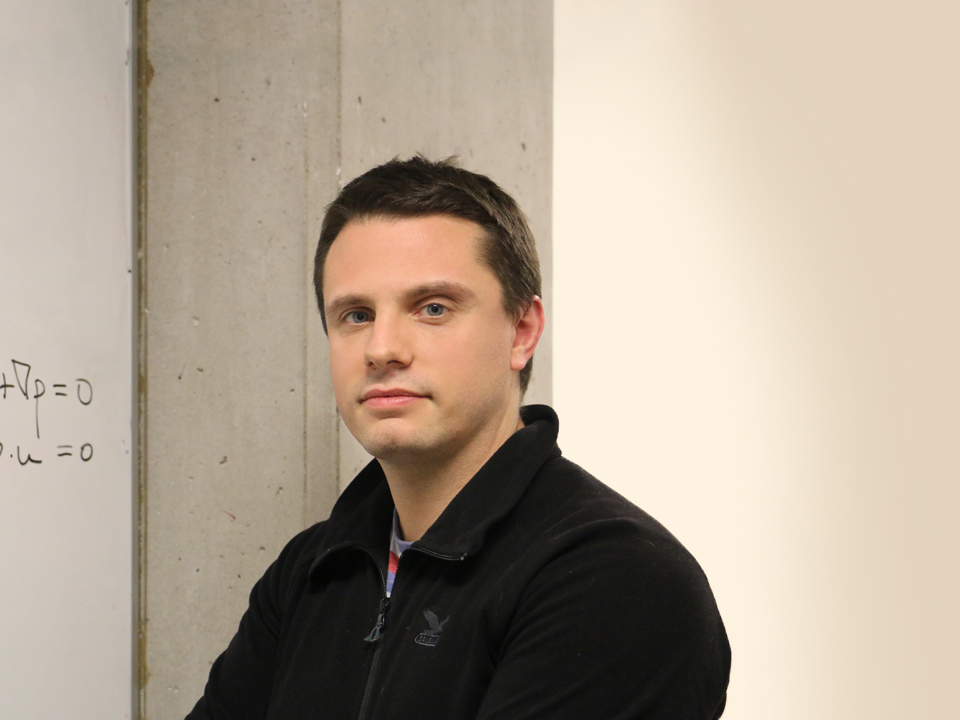
Narrowing of the arteries is the cause of heart attacks. It is present in a large part of the congenital cardiovascular malformations. For that reason, improving its diagnosis is a concern for the sciences and for Cristóbal Bertoglio, researcher at the Universidad de Chile’s Center for Mathematical Modeling (CMM). His team designed a mathematical model that would allow less invasive examinations of the circulatory system.
“We want to know clinically relevant variables and, in particular, blood pressure jumps between points of an artery that is obstructed, for example, with excess cholesterol accumulation,” explains Bertoglio. “Doctors measure the pressure difference at points before and after strangulation. In these cases, the difference is much greater than in a healthy artery.”
However, there are problems with the two methods currently used to calculate those pressure jumps. Ultrasound is inaccurate and is just the first approach. The insertion of a catheter overcomes this, but requires the patient should be anesthetizes, a medical team guiding the insertion of the device using X-rays, and a pavilion blocked.
Bertoglio and his collaborators –among them Axel Osses, also of the CMM, along with the students of the doctorate of Fluid Dynamics and Mathematics– are developing tools to avoid the use of more precise catheters. They do integrate magnetic resonance imaging with mathematical models.
“The magnetic resonance is very flexible and precise, which is an advantage. It allows to measure with great certainty the cardiovascular system,” says Bertoglio. “You can not only observe the anatomy of an artery, but also measure the speed of blood.”
By combining the velocity measurements and the fluid mechanics equations, you can calculate the pressure jumps of the arteries. The team of researchers has developed more precise methods with measures of speed in 3D that are being validated experimentally at the Universidad Católica’s Centro de Imágenes Biomédicas. And the results are very promising.
The problem is resonance takes longer than an ultrasound, in addition to being more expensive. For this reason, the team continues developing algorithms that use fewer speed measures (for example 2D) without compromising accuracy to reduce patient time on the resonator and exam costs.
“In this case, you don’t ask to the doctor for the best possible data, but that one that he has already acquired. You will offer him or her information on the pressure jumps that can be clinically valuable,” concludes Bertoglio.
To Europe
In June, Cristóbal Bertoglio will leave the Center for Mathematical Modeling and will continue his academic track at University of Groningen in Netherlands from July. The CMM thanks his work to the research conducted by the Center.
