
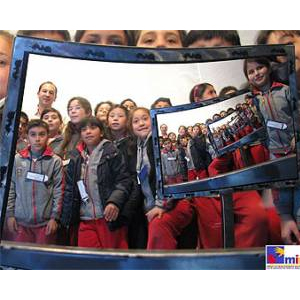
Discovering that “the infinity couldbe in a finite space” is the general concept of the demonstration, which wasopened in September at the Mirador Interactive Museum (MIM) in Santiago and is basedon the work “Gallery of Prints” (1956) of Dutch artist MauritsCornelis Escher and the processing line, raised by the mathematicians Bart deSmit and Hendrik Lenstra Jr. (2003) to finish the work, so far inconclusive.
The exhibition developed in collaborationwith researchers from the Department of Engineering Mathematics, DIM allows itsvisitors “to discover that constructions that seem impossible, there are not, explainedIvan Rapaport, Head of Research of Anillo en Redes Project.
“Our purpose is arousing mathematical curiosityin children. We decided to advise the MIM in the installation of two exhibition:'Square Wheels', which opened in 2007, and now 'Find the Infinite', which beganon September 25. Always the idea is pushing people to question the reality,putting them in front of mathematical constructions aesthetically beautiful andunusual, “says Rapaport.
The exhibition joins the math with art. To do this, the researchers used asoftware based on a mathematical operation called processing line, resulting inan stunning photography of people who are looking at it.
“This is something unique in theworld,” said computer scientist and mathematician, Nicolas Schabanel, ofAnillo Project. “In museums, physicists show their work as experiences, donot talk about the equations that they resolve, but math is much moredifficult, because the objects that we manipulate are abstract. Now, with thehelp of computers you can see, and this allows us to be on equal footing withphysicists to show an experience of science,” he said.
As the researcher explained, what you seeon the screen is a transformation of the image captured by a camera that isover the screen and that is a reproduction towards infinity of the same imagetaken originally. What happens in this exhibition and in the same piece ofEscher also relates to the so-called Droste effect (image that contains itselfinto a smaller version, which in turn contains another like smaller, andtheoretically infinity).
