
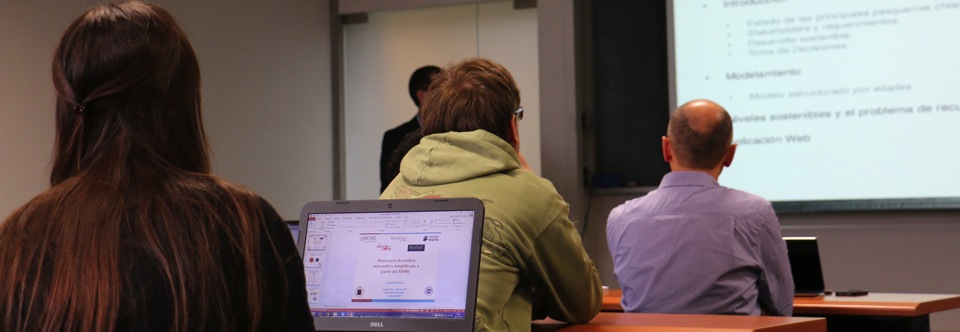
The fourth edition of Bionature meeting unveiled the progress that the research group of the same name has achieved. The team is one of the seven groups Ciric-Inria Chile and its members are researchers at the Center for Mathematical Modeling (CMM) of the Universidad de Chile and three other higher education institutions.
“This meeting allows us checking the new researches, and the progress of our students and some of our researchers,” explains Hector Ramirez, CMM researcher and organizer of the event.
In total, nine lectures showed the advances achieved by projects developed by the group Bionature.
“After three years of projects, we completed a first stage of collaborative work. It was interesting to learn why we must work together,” said Andrés Donoso from Inria Chile in the introductory talk. He highlighted 13 indexed publications, ten international conferences, and research projects with the public and private sectors.
Work in progress
Gustavo Vargas, PhD student at Universidad Católica de Valparaiso (PUCV), showed the results of the production of biogas processing waste from the wine production in the Bionature’s mobile test plant in the V and VI Region.
Juan Carlos Ortega, from Universidad de la Frontera, gave details about an alternative to process wastewater from direct osmosis and produce biogas reversing the current process of an aerobic stage, first, and an anaerobic phase, next.
After, INRIA engineer Maximiliano Olivares showed the evolution of an interactive web tool that proposes and compares recovery strategies for the Chilean hake. The new version of this tool includes new functionalities such as the incorporation of the by-catch, among others.
In his talk, CMM engineer Pablo Koch explained how he added a stochastic uncertainty factor to Chilean Mackerel fishery dynamics in order to find what is the optimal catch that keeps the balance and avoids the fish scarcity.
Fabio Carrera, PhD student from PUCV, addressed the impact of odors on the environment. He did it by considering dispersion of emissions and meteorology to detect the impact of the odor and the wind.
PUCV researcher Giannina Giovannini worked on the creation of a simplified mathematical model from ADM1 to improve the control strategy in a plant.
Finally, Carlos Martinez, from UFRO, modeled a biogas purification process using microalgae.
The closing talk was given by Claude Puech, director of Inria Chile, who outlined the stage two of Ciric from the strategic areas of development of the French center.
