
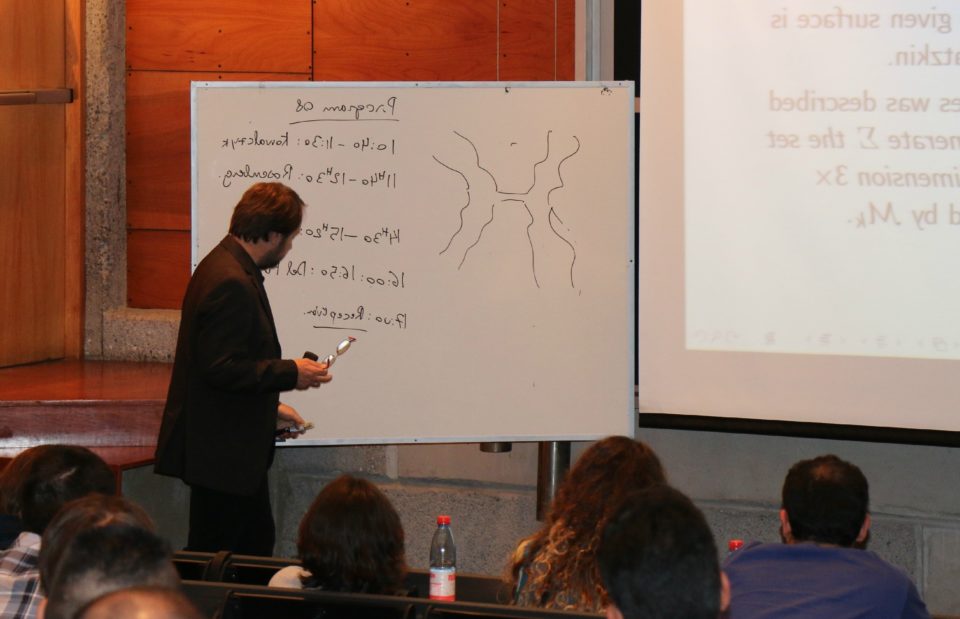
Seldom are held in Latin America such international events like the ICTP–Cimpa Research School (acronyms for International Centre for Theoretical Physics and Centre International de mathématiques Pures et Appliquées) , whose local organizing committee was comprised of the Center for Mathematical Modeling (CMM) of Universidad de Chile and the Pontificia Universidad Católica (PUC) from 8th to 15th April 2015 in Santiago. Indeed, seven Cimpa Schools on average take place in this continent per year. But it is even less usual that Cimpa and ICTP support jointly a school.
The creation of CIMPA followed the recommendation of the United Nations Educational, Scientific and Cultural Organization (Unesco) given in the 70s in Kenya to foster research and higher education in mathematics in developing countries.
“Mathematicians agree to share their knowledge, whereas in some other scientific fields competition is higher and experts have more constraints to spread what they know”, pointed out Ahmad El Soufi, scientific officer for Cimpa. In this sense, he stated that there is not a similar institution like this one in the world. El Soufi added that lecturers participate on a volunteer basis, so this kind of activities can not be so easily promoted outside the area of mathematics.
The event aimed to present to students and young researchers how tools from geometry and analysis of partial differential equations can be combined to obtain interesting and new results. “At CMM we are making research in this area. With Cimpa we expect to build and to maintain an international network of contacts, as well as to give visibility to our work”, stressed Michal Kowalczyk, local organizer of the activity.

This school, which arrived for first time in Latin America in 1991, included four mini-courses and several research talks. Some of them were lectured by world-renowned mathematicians like Frank Pacard, from École polytechnique (France), or Camillo De Lellis, from University of Zürich (Switzerland). Manuel del Pino, CMM researcher and National Prize of Science 2013, also talked on the opening day of the school. But young researchers had the opportunity to take the stage too. This was the case of Asún Jiménez (Universidade Federal Fluminense in Brazil): “As in Latin America there are high-level mathematicians, this activity helps to seize our full potential through North-South cooperation”.
80 people attended the event, mostly from Brazil and Chile. “Specially in Brazil there is a very active group in differential geometry, with recent awards in the field. It is time for these two countries, which frequently travel to Europe but have little contact between them afterwards, to join forces”, highlighted Laurent Hauwirth (Université de Marne-la-Vallée, France), scientific committee´s member of the ICTP-CIMPA School.
An international milestone
Hauwirth, along with Mariel Saez, applied to Cimpa last year to host the activity as administrative and scientific coordinators.
“We seek to keep a geographically homogeneity when it comes to choose the school”, remarked Fernando Villegas, scientific at the ICTP. This entity, whose headquarter is in Trieste (Italy) and was founded in 1964 by the late Nobel Abdus Salam, sponsored along with Cimpa this school. Aiming to be a major force in stemming the scientific brain drain from the developing world, ICTP aimed to foster the excellent mathematical situation of Chile and Brazil.
Cimpa was founded in 1978 and is based in France. This non profit organization is sponsored by Unesco and supported by many mathematicians and institutional members like the French, Swiss, Norwegian and Spanish government. Its schools are usually an introduction to the recent researches in a field of mathematics, which means, pure and applied mathematics as well as related subjects such as computer sciences and theoretical physics.
More photos in our Flickr gallery
