
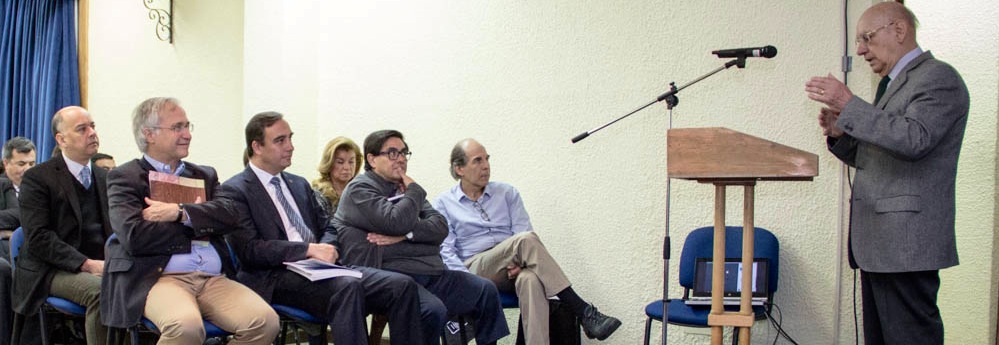
The new opportunities for the southern part of Chile brought with the building of a high-speed photonic network, a technology data center park, and a university in the Aysén Region were analyzed at Jornadas Tecnológicas Patagonia 2015, organized by regional authorities of Aysén and Magallanes with the Center for Mathematical Modeling from Universidad de Chile (CMM).
A total of 22 experts from different institutions joined in these conferences held in January 24th in Punta Arenas and January 30th in Coyhaique.
The CMM was represented by its Director Alejandro Jofré, the Chief Innovation Officer Eduardo Vera and researchers Alejandro Maass and Patricio Felmer, who is National Science Award. From University of Chile, president Ennio Vivaldi and academic Steffen Härtel, from Faculty of Medicine, attended. Among the political authorities, regional intendents Ximena Orders, from Aysen, and Jorge Flies, from Magallanes, talked; Erick Zuñiga, from Subtel, and Pablo Fernández and Andrés Zahler, from the Ministry of Economy, came too. Other speakers were José Palacios, from Reuna; Álvaro Fischer, from Fundación Ciencia y Evolución; Jorge Ibsen, director of Alma; the National History Prize Mateo Martinic and the lawyer Enrique Alcalde.
The event also featured international guests as Maurizio Arienzo, CEO of Novaware Inc. (New York), Fernando Liello, researcher at the Italian network of academic and university research GARR), and Yuji Inoue, chairman of Toyota-ITC (Japan) .
In the meeting, the experts explained that, if companies and government start to importantly use Big Data, high performance computing would need high volumes of electricity. This will be unviable to continue centralizing this tool in Santiago. Based on that, an environment with a great potential for energy appears as the precise place to build a powerful data center, explains Vera: “All the conditions for installing a cluster at service of the country, a technology data center park, in Patagonia, where you can find abundant energy that in a moment was thought to be transmitted for consumption in Santiago. Now, the idea is to use this energy in the South and have access to dark fiber in the region”.
In that sense, building a photonic network linking the southern zone with the rest of Chile is key, because the volume of data expected to process and transmit reach to petabytes (1015 bytes).
This infrastructure would not only have a positive impact on the region, but also in the opportunities supercomputing capacity will bring for the mining industry, biomedicine and other areas.
