
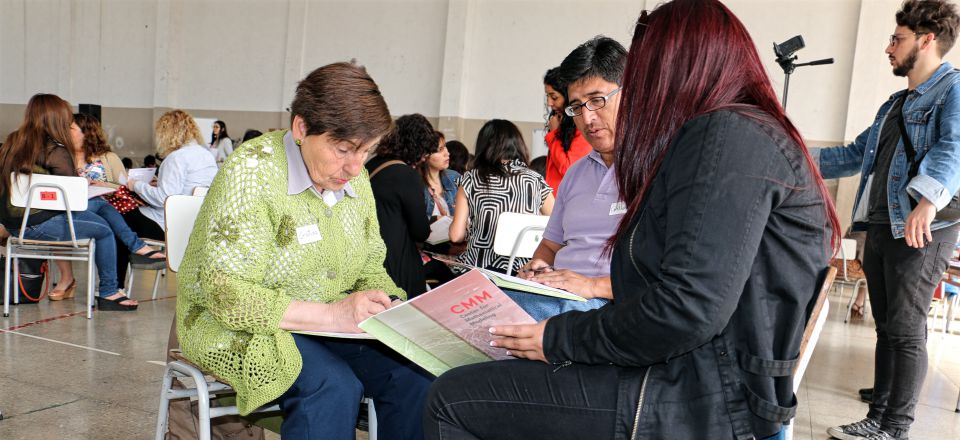
In November 21th, more than 120 teachers from La Florida commune participated at the ‘RP-Acción Activando la Resolución de Problemas en las Aulas’ workshop headed by the researcher at Universidad de Chile Center for Mathematical Modeling (CMM) Patricio Felmer.
This activity was one of three types of workshops taught in seven regions of Chile by ARPA Project, which involved researchers from CMM and Center for Advanced Research in Education (CIAE). Over one thousand teachers from cities such as Iquique, Antofagasta, Valparaiso, Rancagua, Osorno, Valdivia, Punta Arenas, Puerto Natales, Povenir, among others, participated in an activity well rated by the attendees.
“The reception has been excellent, we see a large group of teachers working enthusiastic to learn more teaching strategies”, said Felmer.
According to the National Prize of Sciences 2013 laureate, in these activities “the teachers worked in groups of three, where they solved problems, doing Math and then pondering on that. Barely they got together in groups, they began to discuss on what happened. They thought about they had done before. ”
“This is a first contact with problem-solving methods in an unprecedented way for them, addressing problems they have not seen before and do not know how to solve it. This experience is invaluable, because allow them to do similar activities with their children in classrooms. They felt what happens when you face a problem and you do not know how to solve it”, said.
“With this event in La Florida we close the year. Now we have the Summer Courses at CMM, but it is a very different activity where the teachers deepen their knowledge about an specific content of Math”, concluded Felmer.
On the other hand, attendee teachers felt were quite pleased and surprised by the workshop methodology that combines contents with teamwork.
“I’m surprised by the approach to the problems. The teamwork is one of the most valuable issues in these activities”, said educational counselor Karla de la Maza.
Something similar happened to Mónica Valdivia, primary school teacher at Liceo José Domingo Cañas: “When I arrived, I thought we were going to listen a talk, but when we started doing these problem-solving workshops, I really liked it, because it was like a personal challenge to seek different strategies.”
“It is said that mathematics is an exact science to teach, but we realized that we all have different ways to work with kids,” said Valdivia.
