
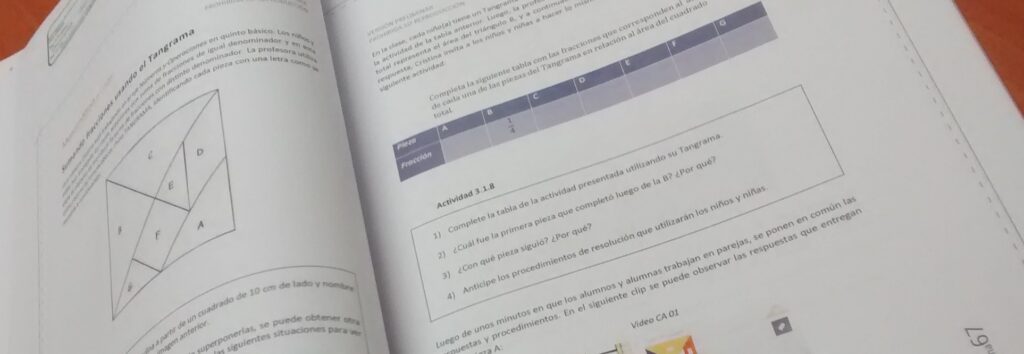
Since April, with the participation of one thousand students from the education schools of 13 universities, the Education Laboratory of the Center for Mathematical Modeling from Universidad de Chile (CMM) is conducting a test of the book Matemática en el aula. Docentes en acción. The project, which was awarded a Development Fund for Scientific and Technological Development (Fondef) of the National Commission for Scientific and Technological Research (Conicyt), aims to contribute to the training of pre-service teachers through the use of videos in universities. This audiovisual material shows real teaching practices recorded in 12 primary schools throughout Chile.
The project started in 2014 and is the follow-up of the work done by the Refip program, which concluded with the publication of four books for initial teacher training organized according to the axes of the school curriculum content: Numbers, Data and Chance, Algebra, and Geometry.
The new text has three chapters: What do we need today to learn mathematics? is the first one and discusses the importance of mathematics for the people’s development, the expertise needed to teach Math, and good learning practices; Beliefs and math anxiety makes suggestions to prevent and work on math anxiety and it also discusses the impact of bias on issues related to equity in learning such as intelligence, gender stereotypes, and brain plasticity; Practices around video analysis activities, meanwhile, includes audiovisual material that will be available online.
“The idea is you can analyze classes with different cases, mathematical strategies or mathematical content, frequent errors of students, classroom management… in short, we seek to incorporate what happens in the classroom to the academic environment,” explained Bernardita Peñafiel, psychologist of the project, about the chapter on video usage. The aim is to encourage discussion between Education students and their professor.
More planning, better results
During the second half of the year, 24 tests will be carried out. In their development, teachers will have to try at least six out of the 66 activities of the book that use audiovisual material. Just one activity is required: that about how to use the videos in the classroom. This, because the book requires professors to plan the discussion depending on their goals, Peñafiel said: “While we propose activities, they lead the class.” Abilities required to analyze what videos are better adequate to the course program and to train certain skills that are not so obvious: for example, do not talk about that doesn’t appear in the video, to respect the professional who appears in the images, not to decontextualize the situation, and to be rigorous in focusing the discussion. This skills are important since each video shows situations that can be used in disciplinary or educational topics of mathematical content.
In parallel, CMM experts are monitoring the work of teachers on the tests: they are having regular meetings with these teachers, filling forms with detailed information of the development of sessions and conducting focus groups with students.
This first phase is a follow-up of work that begun in March 2014. At this preliminary stage, professors from different universities were interviewed before to start designing the contents of the book. In parallel, a first round of classes in schools was recorded with an amateur camera. The research team analyzed these lessons and, with that diagnosis, conducted workshops in Santiago and Concepcion in August and November, respectively. On these occasions, the recorded teachers were invited and their good practices, highlighted. This work of analysis and self-criticism was deepened through individual interviews, where they received a report with suggestions. From these comments, each teacher redesigned and planned his or her class supported by two CMM researchers. Thus, the team recorded the session again. Now, with professional cameras and a cameramen.
“We wanted the classes to be as spontaneous as possible. Portraying what happens in the classroom with all its complexity. It was a labor from May to November, when classes were recorded. All this process was a coaching for the teacher,” held Peñafiel.
The book was designed based in this information: the videos were analyzed, the clips edited and activities designed. In addition, two other chapters were written.
Today, the chapter three is being tested. However, coincidentally, workshops are being made at five universities on chapters one and two to see how they are used. This process of communication and feedback will see it’s the final text by the end of this year.
[box]Book testing universities
In Santiago:
• Universidad Diego Portales
• Universidad del Desarrollo
• Universidad Santo Tomás
• Universidad Alberto Hurtado
• Universidad Católica Silva Henríquez
• Universidad Metropolitana de Ciencias de la Educación
• Universidad de las Américas
In regions:
• Universidad de Tarapacá
• Universidad de las Américas
• Universidad de Concepción
• Universidad Católica de la Santísima Concepción
• Pontificia Universidad Católica de Villarrica
• Universidad de Magallanes[/box]
