
A significant improvement in the modeling and numerical simulation ability will be achieved by the Center for Mathematical Modeling (CMM) of the Faculty of Physical and Mathematical Sciences (FCFM) of the Universidad de Chile Universidad de Chile School of Engineering and Science, due to the systems integration of the powerful IBM iDataPlex computer.
With an investment of over 600 thousand dollars, the computer will help to solve problems in different areas of knowledge, for example, to calculate optimal investments and operations for complex energy and telecommunications networks, to simulate complex environmental conditions in mining projects estimating with much higher precision available water resources in the basins of northern Chile, as well as the dispersion of land and air pollutants.
Its capabilities can also be used for the study of natural disasters and risk analysis as well as for the analysis of real-time images from medicine and astronomy.
“We hope this computer will support the activities in frontier science taking place in the country establishing a wide cooperation network that uses high-performance computing (HPC) to deliver strategic advantages to the industrial sector in Chile, in order to make it more competitive” pointed out Claudio Baeza, head engineer of the HPC Laboratory and the Grid Initiative at CMM.
In addition, this new computer will allow both the Center for Mathematical Modeling and the country, to form a group of highly qualified experts in parallel computing and distributed computing in close collaboration with the most advanced data centers in the world.
Baeza said that “the benefit it will bring to the academic community is not only a decrease of calculation time, but also the speed in handling much larger amounts of memory, a must to significantly increase the number of calculation elements.”
This is possible because the equipment is “HPC” or “High Performance Computing”, and its calculation power is the equivalent of about 1,700 personal computers, the most powerful in Chile and one of the most powerful in South America. This calculation capacity is achieved thanks to its 528 computational kernels, and 80 others to support.
“For IBM it is very important to deliver solutions that bring new capabilities to their customers. With this computer, the University of Chile will generate new knowledge for the country using a tool with high efficiency and scalability, with the support of HPC Research Center of IBM, located in Austin, Texas. iDataPlex is environmentally friendly because it has the IBM Rear Door Heat Exchanger technology, which reduces the use of air conditioning for cooling. It is also a system that uses up to 40% less energy than other similar capacity”, said Francisco Escala, IBM Systems Manager Chile.
The Director of Innovation and Development at CMM, Eduardo Vera, noted that the processing and analysis of images in an automated manner through new parallel computing algorithms, is an emerging area with a great importance. “In that sense it is estimated to have particular significance in medicine, biotechnology, mining and astronomy.”
The equipment will be available to the national scientific community which requires the use of high performance computing, so those interested are invited to contact Claudio Baeza (cbaeza@dim.uchile.cl) for more information.
| Ceremony of implementation
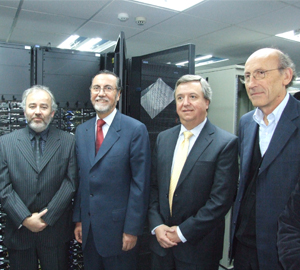
With the presence of Víctor Perez Vera, the Rector of the Universidad de Chile, the General Manager of IBM, Luis Siles, other executive high places of the company, authorities of the FCFM and of the Center for Mathematical Modeling, carried out the ceremony of implementation of the super computer last Wednesday, the 28th of April. The Dean Francisco Brieva, emphasized that it is “an exceptional machine for what already exists in Chile, since it reflects the best in available technology. With its enormous capacity of calculation is going to meet opportunities to important groups of investigation in the country .” The Rector Perez valued the relation established with IBM, “entity with which a wide path has been supported in managing equipment and training of human resources “, indicated. Jaime San Martín, The Director of the CMM, emphasized that the incorporation of this modern equipment ” will give important fruits in the future years “. In this line he remembered its arrival, Friday, the 23rd of April, caused great curiosity among academicians and students. Such a situation made it think how it was the environment lived ” when the first computer came to the Faculty in the 60s.” The faculty relieved that this technology “is present in the first world, in almost all the areas of the knowledge ” and that to have access to the capacity of calculation that drinks ” marks the difference between do or not to do advanced science.” “University groups of investigation already have demonstrated interest to use this equipment as soon as possible. Therefore, we are training a users' network that cover a wide range of scientific challenges,” he expressed. While Luis Siles, General Manager of IBM, shared his ” pride and great satisfaction for taking part in this significant technological presentation. Certainly with the advanced technology that it is incorporating, the CMM will be at par with the big centers of investigation of the world.” “We are doing together (University – Company) a contribution to Chile, a country that seeks to progress by means of the science and the intelligence,” he relieved, affirming that the equipment” will be at the level of the knowledge that the academic community has. Because of it, we hope that this one is the first step for stages of major collaboration.” Collaboration U. De Chile On-line |
