
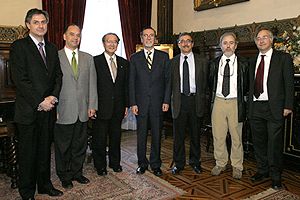
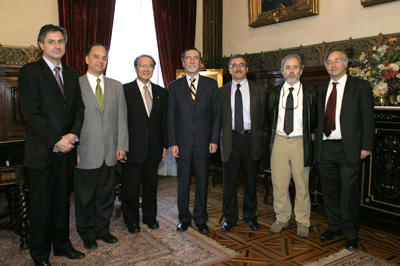
The initiative is coordinated by the professors of this center, belonging to the Faculty of Physical and Mathematical Sciences, Jaime San Martín, Eduardo Vera and Alejandro Jofré. They visited Casa Central together with the experts in Innovation José Luis Daza, Yuji Inoue and Maurizio Arienzo to discuss with the Rector of the U. of Chile, Víctor Pérez Vera, about the topics in which the academy can continue contributing to the productive development of the country.
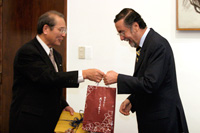
Last Wednesday, October 15, Chilean economist José Luis Daza, resident in the United States; Maurizio Arienzo, Italian physicist specialized in technology; and Yuji Inoue, President and CEO of the Japanese consortium Telecommunications Technology Committee, attended a protocol greeting with the Rector of the University of Chile, Víctor Pérez Vera. Their visit to the country is part of an invitation from the Center for Mathematical Modeling (CMM), of the Faculty of Physical and Mathematical Sciences (FCFM) of this university, to analyze the formation of an industrial committee for CMM.
They were accompanied by Universidad de Chile FCFM professors Jaime San Martín, from the Department of Mathematical Engineering and Director of the CMM; Eduardo Vera, member of the Department of Electrical Engineering and Director of the CMM Project Department; and Alejandro Jofré, Deputy Director of the CMM.
An academic initiative
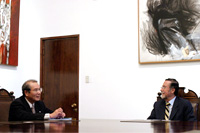
“As part of the Center for Mathematical Modeling we are trying to create an industrial committee, so we have invited three interesting people who are at the interface between academia and industry,” said Professor San Martín.
“We want to find out what an industrial committee would mean to improve our output in productive terms”, added the academic.
He also explained that “our idea is that (these three experts) tell us what the role of such a committee is in the world. Each one has his own vision of what it means and what its scope should be”.
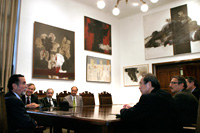
Rector Pérez Vera explained to the visitors that the Chilean government is currently trying to position the topic of innovation at a national level, for example through the National Innovation Council for Competitiveness.
In this sense, Yuji Inoue explained that the Japanese consortium Telecommunications Technology Committee seeks to optimize the way to carry out technological changes in the context of a developing country. It is, then, about how to use the technology: a procedure that in Chile becomes valid, for example, in the context of the national definition of the standard that will be used for digital television.
Creating opportunities in Chile
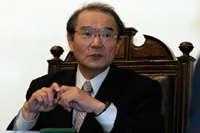
The work of the experts is focused on cementing long-term working relationships. To this end, they will be in constant communication with Japan, creating opportunities to operate effectively in Chile.
“The human work is essential. We need it to have an impact,” explained Professor Eduardo Vera during the meeting, also highlighting the high degree of relations that Japan has with other Asian countries in this area.
The professors of the Faculty of Physical Sciences and Mathematics also expressed their willingness to collaborate with other faculties in the realization of the industrial committee, such as Medicine or Social Sciences, given the complexity of the problems of innovation in Chile.
At the meeting, Rector Víctor Pérez Vera also reported on the Bicentennial Program for Advanced Human Capital Formation, which will allow Chile to send postgraduate students to study abroad, and the concern that this generates in the national campuses, as it could cause a weakening of them if the Program is not complemented in the proper way.
In this regard, economist José Luis Daza commented that investing more in bringing in foreign professors could contribute to generate more networks than sending people to study in other countries, since, in his opinion, the aim is to have a more competitive university system.
By Marco Antonio Braghetto
Photo credits: Pablo Madariaga
Previously published in Spanish by Noticias Universidad de Chile
