
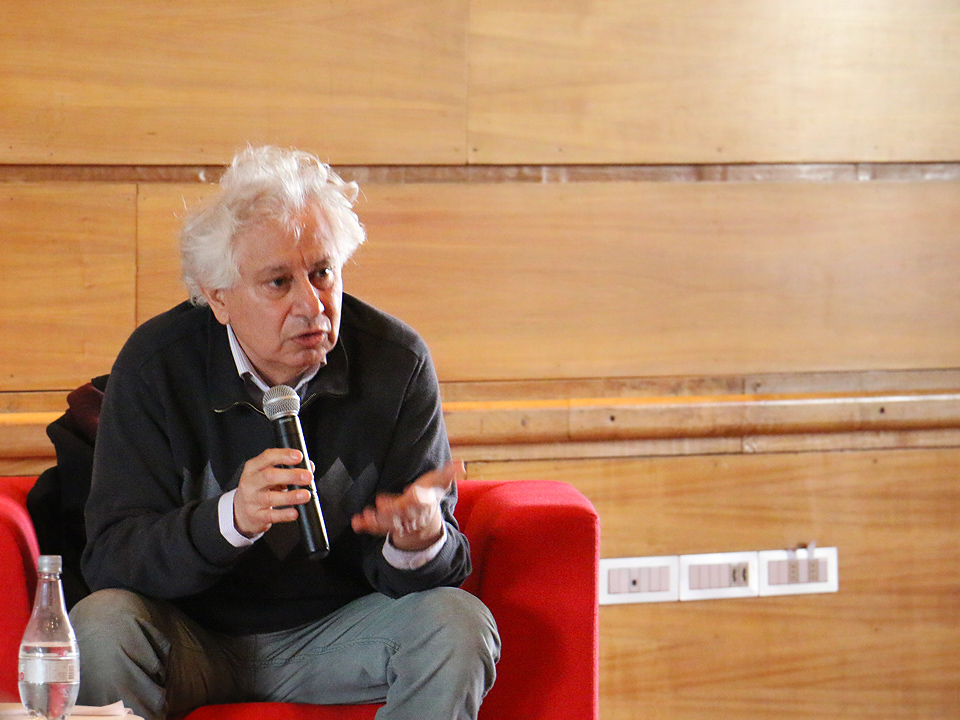
Servet Martínez, researcher at the Center for Mathematical Modeling from Universidad de Chile, joined in the ‘Thinking the Universidad de Chile in changing times’ second forum, organized by the Faculty of Physical and Mathematical Sciences. This panel discussed the status of research facing challenges for the Chilean society of the XXI century and sought to generate discussions within the University Senate’s proposal to redefine the statutes of U. de Chile.
A crucial labour of modern science is helping us navigate in a world of information overload, where much of that information is false,” said the CMM researcher.
He was accompanied by Mario Hamuy, from the Department of Astronomy; Jorge Hidalgo, National Prize of History and reseacher at the Department of History; Alejandro Valdivia, from the Department of Physics, Faculty of Science, and Manuel Antonio Garretón, from the Department of Sociology. The panel was moderated by Laura Gallardo, director of Centro de Cambio Climático y Resiliencia.
“We are in times of change and student manifestations. There is questioning to higher education, its financing and its structure,” said the moderator, wwho noted that this occurs in a context where U. de Chile ranks first in the country´s research field, the government´s announcement of higher education gratuity and the expectation of the scientific community about the creation of a Ministry for Science and Technology.
According to Hamuy, climate change is a fundamental problem to be faced by the university: “I think the answer will come out from science. It is looking at the future andthe innovation.”
HHidalgo said that issues such as ethics will occupy an important place in future discussions. In that regard, he voiced “social sciences seek not only to have better language, but also to have a better democracy.”
Valdivia was the first to address the issues raised by the reform of the statute. “With more stability, you can think more long-term problems,” said the professor at the Faculty of Sciences. “The university’s problems of governance waste time of that part, which is the tranquility and stability. We should concentrate on the major milestones. Universidad de Chile has the potential to become one of the 50 largest in the world.”
Then it was Garreton´s turn , who stated that social sciences should not only be assessed for their indexed publications, but also for its impact on society, one of its most important dimensions. He also proposed creating interdisciplinary institutes on issues such as climate change, cultural studies or analysis of the social structure in Chile: “There are certain essential areas to develop. They can not be reduced to the sum of the disciplines.”
Servet Martinez closed the panel.
“The university is growing, creation, dissemination of knowledge in the contemporary world. That requires unrestricted freedom of thought. This is a crucial point,” he said.
He suggested that the structures must answer to the mission of Universidad de Chile and its tradition. And, if they do not, the academic authorities should oppose to them.
He added that existing structures should be flexible enough to incorporate interdisciplinarity: “The challenge for Chile is to collaborate. To help, you don’t need to create all brand new instances. Instances will reflect what is being done.” As an example he puts the work CMM is developing in education, with the collaboration of teachers, psychologists, sociologists and other professionals, and the NLHPC where 17 universities, research centers and other institutions converge to develop projects that use supercomputing resources . In that sense, he also emphasized on the Conicyt library, which has been supportedby the Chilean scientists.
The CMM researcher also referred to the debate on the fundamental regulatory framework of Universidad de Chile: : “Trivializing the problem using the statutes is the greatest disservice you can do to the University: that divides it when it needs to be at theforefront, united, with a very strong voice. We must defend the university to continue producing knowledge.”
The activity ended with a round of questions from the audience.
