
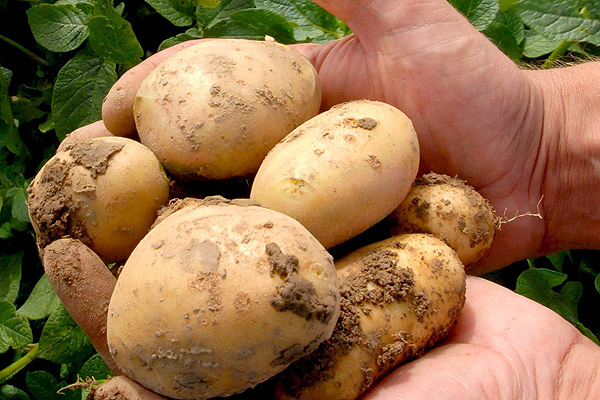
A key role had three Chilean scientists decoding the genome sequencing of potato when they design the model experiment to follow and also produce a finished map of the tuber�s genes.
Boris Sagredo and Nilo Mejia, of the Instituto de Investigaciones Agropecuarias (INIA) who along with members of the Laboratory of Bioinformatic and Mathematic of the Genome (LBMG) at the CMM-U. de Chile, joined in 2006 to a consortium of international researchers to sequencing the potato genome to enhance the quality of a seed so important to humans.
Boris Sagredo, INIA�s scientists told Emol that from the year 2009 it was discovered a new genotype of the potato. That, helped by new sequencing technologies were according to him, the main factors that today we may be talking about the significant progress he was part and which will be published in an upcoming issue of the journal Nature.
With these tools, Sagredo said that he and the other national researchers began to design experiments to generate an ultra-dense genetic map of the potato, which was composed of 2,200 markers (micro sequences), of which 1800 were decoded by national professionals. The rest was deciphered by other scientists in the consortium.
For that, Boris Sagredo explained they took the progeny of the plant to be sequenced (offspring) flowers were generated and also there was a crosses of them to afterwards studying the gametes.
Thus it came to the genome sequencing of potato, a product which have at least 39,000 genes, nearly twice that of the human being.
For its part, the director of research, Glenn Bryan, from the of the Institute of James Hutton, Scotland, said: “The sequencing of this genome is an important step in understanding the biology of the potato”, which can “speed up production of new varieties, “by selecting genes with particular characteristics that affect the color, texture or flavor.
Although the discovery is of major importance on the third most important food for humans, experts note that the analysis of the genetic sequence of the plant will take several years for which results can be seen.
Despite the importance of this scientific feat that could help solve the problems of famine in developing countries, experts warn that the analysis of the genetic sequence of the plant may take several more years.
The original text of Emol here (In Spanish)
