
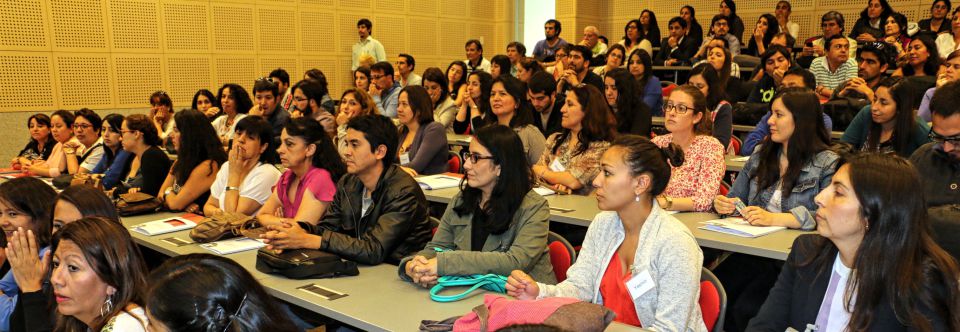
More than 170 teachers joined the last Summer School on Mathematical Education, organized by the Professional Development Unit at Universidad de Chile Center for Mathematical Modeling. The number of attendees increased in 20 comparing with last year.
The activity is part of the offer of continuing studies in education offered by CMM as a tool to improve the way the Mathematics are taught and learnt in Chilean classrooms.
Teachers joined specialized problem-solving courses for preschool, primary and secondary classes. They faced different cases and situations similar to those students address in classroom.
“These are courses for in-service teachers, for their professional development in the Mathematics subject. In these, various topics such as fractions, geometry, arithmetic, probability and data are addressed,” explained the program coordinator Natalia Ruiz. “For several months we were preparing the content of these summer courses and its methodology”
For second year, the CMM Professional Development Unit provides this program. According to the organizers, last year’s success boosted enrollment and attendance.
“Normally, teachers feel surprised, because other courses are more like a traditional lecture, with the speaker talking in front of an audience. Instead, these courses are very practical. That surprises positively because they get into the problem-solving area”, said CMM researcher and Academic Director of the Program Patricio Felmer.
Felmer noted the work performed by the Laboratory of Education during last year drew the attention of many teachers who registered across the country, including cities such as Santiago, Arica, Copiapó, Valparaíso, Aysén and Punta Arenas.
“There are teachers from all over Chile who attended workshops last year. This is very interesting because we are planning to create a scholarship especially for rural teachers. They have few opportunities to have more meetings with teachers. It is something to be encouraged with financial assistance because they live far away and usually are from single-teacher schools. It’s a topic that we need to support” concluded.
