
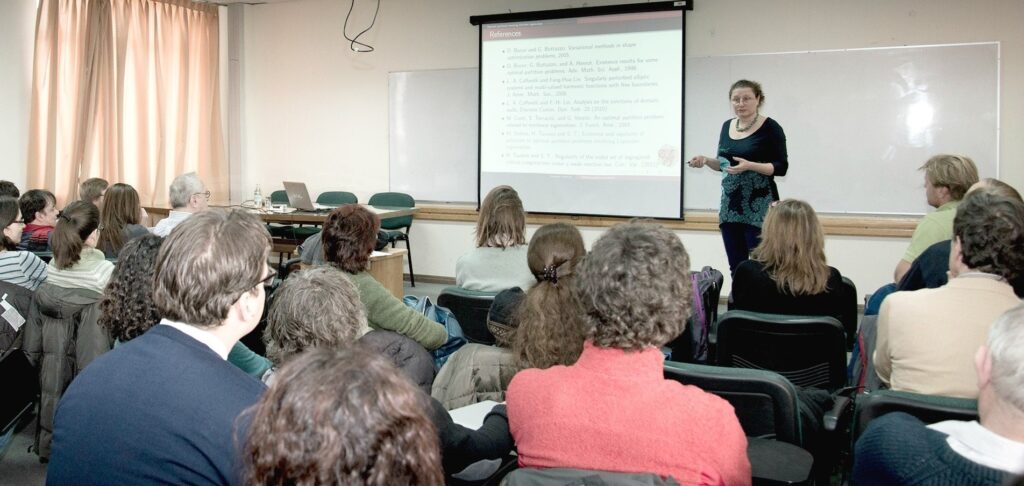
During the first week of March, Punta Arenas received some of the most world-renowned mathematics. The Nonlinear elliptic Partial Differential Equations (PDEs) at the End of the World Congress, held along with the Center for Mathematical Modeling (CMM) of Universidad de Chile, brought 29 international researchers and one National Prizes of Science. They all gathered in order to discuss about the last advances in the area.
“Many congresses about PDEs are held in the world, but one at the end of the world is unique. It might not have taken place a congress at such a southernmost point in the Earth never before. Therefore, it is a special occasion for our knowledge field and for mathematics in Chile”, pointed out Juan Diego Dávila, the main organizer.
Manuel del Pino, attendee and National Prize of Science 2013, explains that Punta Arenas provided an “excellent” infrastructure for the event. So, Magallanes should be promoted as a region to stage this kind of activities. “It would be a way to integrate the country, not only through politics, but also through culture”, highlighted del Pino.
This event, which came out of an Italian-Chilean initiative, invited 35 speakers. Among them, Henri Berestycki, lecturer at the École des Hautes Études en Sciences Sociales (EHESS). His The effect of domain shape on reaction-diffusion equations talk discussed some reaction-diffusion equations motivated by biology and medicine of bistable type. It aimed to understand the effect of the shape of the domain on propagation or on blocking of advancing waves.
The CMM researcher, Salomé Martínez, gave a talk entitled Integrable steady states for non-local equation. As Berestycki, her study also has applications in the movement of species. Particularly, it focuses on long-range interactions, whereas the classical models used to analyze of short -range ones.
Young researchers also attended the event, like CMM postdoc Jorge Faya: “Sharing time and listening to prominent researchers was encouraging and enriching”.
Participants were very interested in working together in the future. They agreed that the results of the event were of high quality. In fact, it was also an opportunity of dialogue for two groups that usually do not meet: fully nonlinear and single perturbations. Thus, as Manuel outlined, in the social activities of the congress like coffee breaks or dinners “a friendship atmosphere could be felt”.
Press coverage
The event attracted the attention of the media and TV channels, radio stations and newspapers published information about the congress.
TVN: Punta Arenas fue la capital matemática de Chile
La Prensa Austral: Armonía y forma: el teorema matemáticos
La Prensa Austral: Punta Arenas, capital mundial de las matemáticas
El Pingüino: Punta Arenas se transformará en la capital matemática de chile durante marzo
Radio Polar: Manuel del Pino talks live on the news
Radio Magallanes: Punta Arenas se transformará en la capital matemática de Chile durante marzo
Radio Polar: Interview to Juan Diego Dávila in Punta Arenas
Radio Polar: Punta Arenas se transformará en la capital matemática de Chile durante marzo
More photos in our Flickr gallery:
[alpine-phototile-for-flickr src=”set” uid=”89937484@N08″ sid=”72157650822767007″ imgl=”fancybox” size=”240″ style=”floor” row=”4″ num=”6″ align=”center” max=”100″ nocredit=”1″]
