
An old technology…
To 176 years the invention the electric car by Thomas Davenport, this type of vehicle has returned to receive prominence as the ideal solution for transporting passengers and cargo in the industrialized world. The first precedent is the development of EV-1 for General Motors in 1989 as the first electric vehicle produced commercially. Indeed, advances in power electronics, traction systems, communication technologies, management techniques, and in particular the storage systems (batteries), have increased significantly the competitiveness of this technological solution. Also, the increasing lack of fossil fuels has made the traditional solutions based on Otto and Diesel cycles lost the appeal in prices that have characterized during the past 100 years. To the previous thing, it is added the international commitment to mitigate and address the effects of global warming by reducing emissions of Greenhouse Gases (GHG). This has led to encouraging research and development of pure electric vehicles (Battery Electric Vehicles: BEV). That is, economic and geopolitical reasons plus the underlying crisis, has come to establish a fertile ground for States that are now willing to encourage and subsidize the change in this industry now 100% dependent on oil.
It's the battery, stupid!
As the famous phrase of James Carville “It's the economy, stupid!”, who was an adviser of the Democrat Bill Clinton's successful campaign in 1992 drove him from his modest governor chair of Arkansas to the White House. In this case, the main reason for this resurgence is the remarkable progress of the batteries, especially given the widespread use of portable equipment such as movile phones and notebook, reaching the current standard Lithium Ion battery wich presents notable features of load cycles, storage capacity and power, no memory effect, etc… what has driven the initial impetus for this revival, making it technically feasible in the standards of the automobile industry.
In fact, it requires a degree of autonomy on a single charge of at least about 130 Kms to cover a minimum level of acceptance for a city-car. The Lithium-Ion batteries reach a storage capacity of minimum energy for this requirement (about 20 kWh) in weight (about 200kg) and reasonable volume (120 liters). At least we can think in enable a commercially car with these parameters, however, industrial objectives to massify industry still needs to reduce the weight about 130 kgs. and about 86 liters volume, both for the same storage capacity.
A separate item is the price, which now exceeds U.S. $ 1.000/kWh which makes it double the price of the vehicle only for the cost of the battery. Although the efficiency of an electric vehicle is four times in comparison to a gasoline one, the savings does not offset the higher initial price for a normal user driving around 15-20 thousand miles per year. This implies that the goal of truly competitive business purpose requires reducing the cost of the battery by 75%, or about U.S. $ 250/kWh. That goal is very difficult due to the high cost of materials of Litium-Ion battery. However, there is a great effort to meet this goal and many developed countries are subsidizing the R & D to achieve it soon.
Another key parameter is the price of an oil barrel, which is linked to the current economic performance of a gasoline vehicle. For example, if the value is doubled to U.S. $ 80/barril current U.S. $ 160/barril, the efficiency in $/km will be reduce to the half for the benefit of electric vehicles.
In several scenarios we studied in the Energy Center (EC) to quantify the balance between all these variables we estimate that with the current oil prices and a cost of U.S. $ 300/kWh battery (it is estimated it will be achieved by 2015) the payback of the higher price of the battery is recovered only in 8 years. However, if the oil price reaches U.S. $ 150/barril (possible scenario in the next 6 years), the payback occurs only in 3.5 years and in that case, the electric vehicle is fully competitive with the gasoline vehicle. That is, in a short time we have a break point to lead this industry to strongly penetrate the market.
But will be there a transition or intermediate solution?
Actually, this transition has already begun, hybrid vehicles are a reality and the trend is to implement the so-called strongly Plug-in hybrids or PHEVs, which are vehicles that combine the technology of electric motors with internal combustion engines. They come with small lithium-ion batteries about 4 kWh. delivering an electric range of about 40-50 kms. The combustion engine works as part of a generator to charge the battery or in other cases as a torque motor driving parallel to the electric motor (one serving in front-wheel drive and the other in back). The batteries can be charged at home through conventional outlets in a couple of hours, which serves to educate the user on the stage to come. However, this technology has the great disadvantage of not making real savings in efficiency (20% maximum) and an initial extra cost of the battery around U.S. $ 4 to 5 thousands. On the other hand, in the medium term operation and maintenance is expensive because of the engineering and electronics associated with the coexistence of both technologies. However, probably coexist for years with the nascent BEV technology fading away the use of oil and increasing the use of electricity.
And what does the automotive industry say…
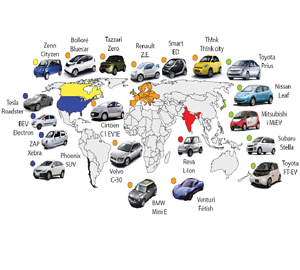
Dozens of pure electric vehicles are being launched to the market. Originally very small and expensive cars, but it is certainly a long-term decision to achieve a market position.
Between 2010 and 2012 virtually all brands launched commercially a model of a BEV to the market.
The paradigm change of a powerful industry…
One of the biggest changes to come is the infrastructure of load of these new vehicles. From service stations and big companies associated to the distribution of gasoline, it passes to the need for electricity distribution companies adapt to the new distributors of energy for transportation. Moreover, this energy may be acquired directly for households (slow load, conventional plug) to load nodes (new service stations) to 400Vdc or industrial three-phase loads that will offer “fast” half-hour or less to 50KW power. This involves a series of changes in user behavior remains to be seen.
Chile, companies and R&D centers
Chile is the principal supplier of Litium wordwide and should be able to take this opportunity. The technology and problems associated with network load and battery development is still growing. Chile may take this advantage in the top of the wave. Let´s remember that Chile had this possibility in 1994, when the Internet started and it was not useful. It is hoped that the country, its government, its enterprises and R&D centers will not make the same mistake. The Energy Center of FCFM- Universidad de Chile is determined to promote the fact of creating awareness of this situation. For that EC is working in several fields and at alliance and association with domestic enterprises and with technological centers of top worldwide at the development of commercial technologies that could be applied in the mentioned areas.
Impact of the penetration of BEV by reducing greenhouse gases and local pollution
Considering the exponential growth of the National Automovile Park, due to the increasing in private cars, the introduction of electric vehicles could have a non-negligible impact on reducing GHG emissions on the base of growth. As a result, it is estimated that private vehicles could emit the order of 15 million tons of CO2e by 2020.
For a hypothetical scenario it was developed the replacement of 1% of passenger cars (about 30,000 vehicles) by 2015 and 5% (about 200,000 vehicles) in 2020. In a second scenario it was carried out the replacement of 3% of passenger vehicles (around 100,000 vehicles) by 2015 and 20% (about 800,000 vehicles) and 2020.
In the most conservative scenario (Scenario 1) there is achieved a direct reduction of emissions of the sector of transport, equivalent to 0.5% by 2015 and 2.6% in 2020. By contrast, the increased penetration scenario (Scenario 2) is achieved a direct reduction in emissions of 1.5% by 2015 and 11% by 2020.
The results for passenger cars (category are most involved in the transport roadman) in the analyzed period are in this case, CO2 emissions are reduced to 2020 by 4.4% in Scenario 1 and 18.5% in Scenario 2.
These results are interesting if they are analyzed one by one from the sector of transport, but considering that the source of energy for this new technology is the electricity, it should make a more complete analysis includes the emissions produced in generating facilities.
If the SIC is considered, the described scenarios previously only would reduce the half of indicated in the previous figure.
From the point of view of the emissions, comparative advantages exist concern of having a mega stationary source (central) issuing intead of thousands of small sources (vehicles), because it has more capacity of control of the application of post-treatment systems for local pollutants or enclosedly system of capture of carbon. This added to a location of a mega source far from urban centers make the final effects different from the configuration of thousands of small sources.
Then the challenge to achieve a full stage to reduce emissions in transportation also involves generating electricity companies, as these results vary directly with the carbonization of the energetic counterfoil of the country. According to Progea, the factor of emission of the SIC mght come in 2020 could nearly double the current one, which avoided reductions by replacing gasoline-powered vehicles nearly offset by the increased emission of thermoelectric power plants. In conclusion, efforts must be made to increase the percentage of renewable generation if positive overall effects on all sectors are expected, not only in transport.
In complement and provided new vehicle technologies have high costs, it is important to consider the savings that might represent for the country stop issuing, up to 2.7 million tons of CO2e per year. This besides to the significant reduction of local emissions (PM, NOx, CO, HC, etc.) with the consequent effects in health and the potential savings in medical expenses. To this one might add the decreased level of concentration of pollutants in the alleys or closed zones of the downtown. Additional,the incorporation of electrical vehicles, mainly in Santiago, generates interesting reductions in noise levels, which translated in health benefits and improvements in the image of the city from the international point of view, as an urban center, and also tourism.
FCFM Energy Center
Program Management and Environmental Economics
Sustainable Systems & ISSRC-LA
1. It is considered an average activity level of 12 487 km / year, consumption of 0.3 kWh / km and an emission factor of 0.4699 kg CO2/KWh.
