
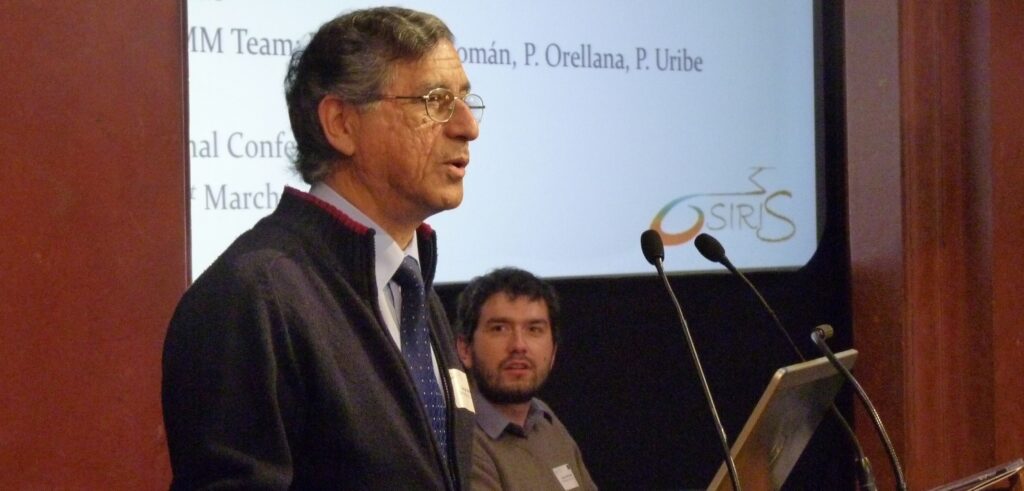
Brussels welcomed on 30th and 31st March the partners of Osiris, a project that is composed mainly by enterprises, academic institutions and European government agencies that develop strategies to reduce energy consumption in the urban rail. During the meeting, the group discussed the results obtained after three years of work. The event was attended by the only non European partner of the project, the Center for Mathematical Modeling (CMM) of Universidad de Chile. For Osiris, CMM created mathematical models and a software that allows calculating energy balances and impacts of temperatures and humidity in the tunnels and stations in a metro network.
The team lead by Jorge Amaya, CMM researcher, has worked for several years in this project, which is financed by the European Union and counts with the participations of Alstom, Siemens, CAF, the Paris and the Rome subway, as well as academic institutions such as University of Newcastle and Vienna University of Technology. In total, there are 17 partners. “The alliances we have and the interdisciplinary character made that Europe required our involvement”, pointed out Amaya.
The event in the heart of Europe counted with the participation of more than one hundred European specialists. The talk of the CMM team awoke great interest, as it included a life demonstration about how to use the computational system, with real data provided by the Paris subway.
Europe expects that the tools created by these scientists and professionals contribute to reduce in a 10% the energy consume for the urban rail sector in 2020, goal set in 2007 by the European Union.
“Osiris is helping European rail operators to reduce their energy bills and the environmental impact of their operations”, said Caroline Hoogendoorn, manager of the Osiris coordinator team.
Specifically, the software produces simulations that calculate the consume and the loss of energy, as well as the temperature oscillation, which can reach up to 10 degrees in metro stations depending on the operations decisions. This affects the comfort of the passengers and the economy, as it helps to compare consumes and reduce expenses when it comes to build or operate an urban railway system.
The Chilean technology is open to future applications. In our country, the Chilean Agency of Energy Efficiency (AChEE, because of its acronym in Spanish) is studying along with team of Jorge Amaya how to use this software in urban trains or subways.
More photos in our Flickr gallery:
[alpine-phototile-for-flickr src=”set” uid=”89937484@N08″ sid=”72157649379023114″ imgl=”fancybox” size=”240″ style=”floor” row=”4″ num=”8″ align=”center” max=”100″ nocredit=”1″]
Photo credits (front page and Flickr): Osiris
