
Despite the heavy investment ininfrastructure made by the Government and the incorporation of regularassessments and training for teachers, performance in the National Assessment,Simce, in 2007 is again disappointing and shows stagnant scores in the pastthree years, especially in mathematics.
These meagre results not only evidence thepoor performance of schoolchildren in this area, but also of those who have theresponsibility to teach these contents: the teachers.
Patricio Felmer, director of Fondef “Tools for Training of Mathematics Teachers” and associate researcherat CMM, acknowledged the difficulties associated with the concept of generalistteacher. “It’s been realized, a little late perhaps, teacher who teach mathematicsin elementary level needed a specialist preparation in the area and in its pedagogy,”he explained.
In addition, Felmer recommended futureteachers to “interact with colleagues and teachers to learn about thechallenges the classroom holds, how mathematics are learned; what activitiesare better, known models of metaphors.”
The key: explaining why
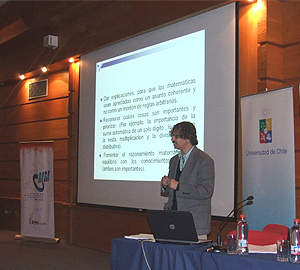
In his second visit to Chile, themathematician Solomon Friedberg of Boston College, USA, shared with those who attendedthe workshop why an elementary teacher need to know math and how he o sheshould be prepare for that. “The mathematics knowledge needed to teachwell is advance knowledge and it is not true that someone who enters universityhas this knowledge,” said Friedberg.
For the Chairman of the Department ofMathematics at
Friedberg also appealed to professionalmathematicians to be involved more actively in the preparation of prospectiveteachers. “Mathematicians, including university professors, must worktogether with mathematics educators and teachers, to adequately prepare the nextgenerations of teachers, at all levels,” he declared.
In addition, the workshop was attended bythree academics who are responsible for proposing curriculum changes inteaching careers. They were: AndresOrtiz, Universidad de Concepción; Claudio Martínez, UMCE and Pierina Zanocco,Universidad Católica de Chile.
The success of
The faculty of the Department of MathematicalEngineering (DIM) and researcher at CMM, María Leonor Varas shared with the attendeessome details of her visit to
The researcher also said that academics incharge of preparing future teachers of mathematics although belong to theeducation department of their universities, are mathematicians with doctoratesand publications in this field, which have become researchers in matheducation.
The presentations of all exhibitors and participantsof the roundtable are available at:
