
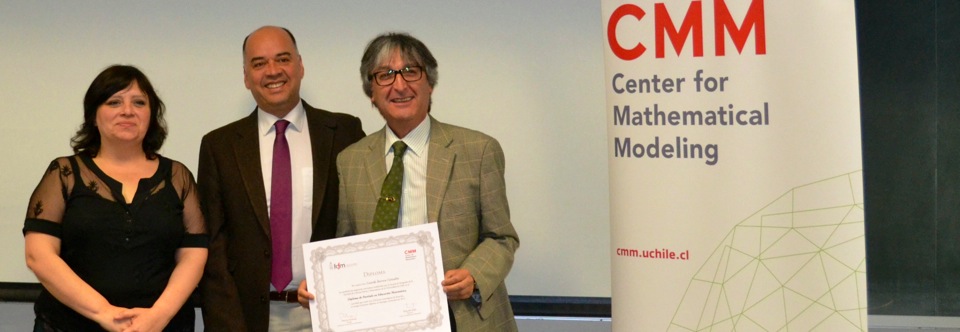
A group of six teachers or teacher trainers graduated as first generation of the first diploma offered by the Center for Mathematical Modeling of Universidad de Chile (CMM): the Postgraduate Diploma in Mathematics Education.
Read the article in spanish / Lea el artículo en español
CMM Director Alejandro Jofré, CMM Education Laboratory Director Salomé Martínez, School of Postdegree Director Richard Weber of the Faculty of Mathematical and Physical Sciences, and Department of Mathematical Engineering Deputy Director Héctor Ramírez, chaired the ceremony.
This is the first experience of this kind developed by the center that, through courses, workshops and diplomas, seeks to transfer the knowledge produced in its laboratories. Particularly, this program was aimed to professionals involved in the initial and continuous training of primary school teachers as well as those who has a role as leaders in their educational institutions.
“It’s a matter of pride to be finishing this first Diploma at the CMM. It is important for us: it opens a new phase in which we are proactive in transfer all content generated here. It was a different proposal, which was based on our work in education,” said Salome Martinez.
Alejandro Jofré featured the history of the Education Laboratory in an kind of experiences that can be repeated in other research areas of the CMM: “This center has, in Education, other projects and, with the help of you and other collaborators, it can develop new adventures in this area, which is a priority these days. But also we are looking to expand into other sectors where the contribution of the CMM is significant.”
Lizardo Barrera, graduate diploma and Dean of Education at Universidad de las Américas (UDLA), spoke on behalf of his course: “More than Mathematics, we have learned about mathematics education: where students’ knots are. And our classes have changed. There are cases of several colleagues at the university where students do not want to miss classes and even have asked to continue with the same professor in the next semester.”
Elizabeth Moreno, coordinator of the first cycle of Mathematics at San Bernardo Abad School, appreciated the Diploma’s work style: “I liked the way the classes were doing. In a very didactic way, very different from what we did in the college. Here, you learned by doing, such as we expects of students in the classroom. The CMM has very good professors, which cannot be founded everywhere. It has the strength that engages students in classes strongly: they complement each others, they help each other and new ideas are emerging that are a complement of the classes.”
The UDLA dean also highlighted the willingness to learn of Diploma’s teachers and students: “From the first time, it was more than we expected for. We were very welcomed. They had an attitude of sharing knowledge more than of teaching it. They looked for the best of us. We went to classes because we wanted. On Saturday mornings or on Friday evenings. At the end, the diploma, the certification, didn’t matter.”
For Richard Weber, a new challenge for the CMM is to increase its offer in continuing training.
“The center must afford the demands of the society. That must be landed. It must take Math to different applications, identifying problems, for example, in public transportation. We have listened about this issue: it has a lot of problems. And people do not identify Math there. A first step is to make conscious that Mathematics is present in a lot of day-by-day problems, such as this one or Health and Energy, for example. This is a huge challenge. It is not trivial. I know CMM colleagues can do it. Next, they have to show the tools. And third, they must land these tools, simplified them in order to make them applicable,” he concluded.
More photos in our Flickr gallery:
[alpine-phototile-for-flickr src=”set” uid=”89937484@N08″ sid=”72157649439560211″ imgl=”fancybox” size=”240″ style=”floor” row=”4″ num=”8″ align=”center” max=”100″ nocredit=”1″]
