
“Students have told me about how transformational the collaboration (in teams of Chileans and Americans) has been for them, by exposing them to real problems and getting them excited about their field and the advances by doing real data science.” With these words, Pavlos Protopapas, scientific director Institute of Applied Computational Science (IACS) at Harvard School of Engineering and Applied Science, defined the experience of living the Harvard-Chile Special Workshop on Data Science 2016 organized by Center for Mathematical Modeling (CMM) at Universidad de Chile .
With the attendance of eight faculty and graduate students from Harvard University, four researchers from CMM , four scientists and four students from other U. de Chile’s units, and two astronomers at Universidad Católica, the third version of this workshop was carried out from January 3rd to 23rd as a relevant milestone in the long-term collaboration between CMM and IACS.
“This activity has contributed in an very relevant way to the growth of CMM Astroinformatics Laboratory, with its development of ‘real-time Astronomy’ for the massive detection of new astronomical events such as early supernovae and asteroids,” explained CMM Chief Innovation Officer Eduardo Vera.
During this team-based intercultural learning experience, Chilean and American students worked together in interdisciplinary groups on a real-world computationally challenging problem drawn from a cutting-edge astronomical endeavor, the Dark Energy Survey. This in a context of an Astronomy processes greater amounts of data every day.
“It’s kind of a data science school where everyone is working on a project as a team and they also learn about other aspects of data science by being together with the other teams and projects. We’re creating an extra layer of forming a research group, a sort of a virtual data science research lab. Kicking off the project by working closely and intensely for a few weeks in the same physical location is a key part of the workshop,” explained Protopapas.
CMM and MAS astronomer and organizer of the event Francisco Förster stressed the group discussion effects: “In an informal way, everybody participated with ideas, points of view or questions that are not always evident for all, given the overspecialization today we have. For Chilean students, discussion sessions are very useful, because not everyone use to talk in public, as this program demands. For both groups it is very rewarding to share with students from other countries.”
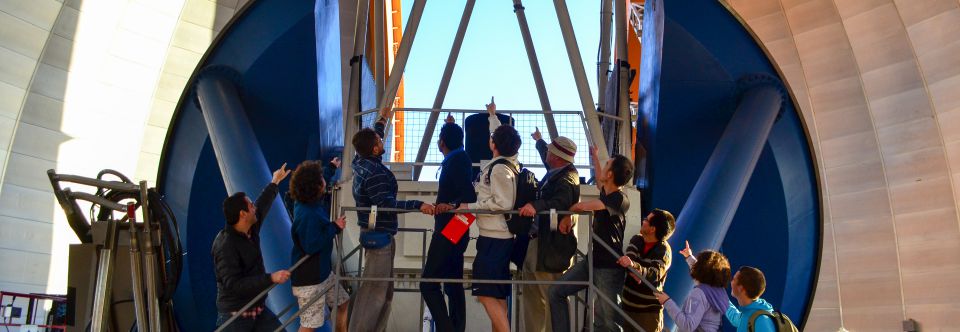
The program included working days at CMM and Universidad Católica, and an overnight stay in La Serena to visit to Cerro Tololo Inter-American Observatory and Gemini South Observatory, meeting the scientists who collect the data. Universidad de Chile Vice President Sergio Jara welcomed the group in a kick-off ceremony at Casa Central’s Amanda Labarca Room.
“We are just starting this format, so we don’t know the most important achievements of this activity yet! This year, we are in our third iteration of collaboration, building upon two earlier shorter-term projects and there are some important results from the previous years. (…) I also think the opportunity to work across universities, across disciplines, and across countries is a big achievement so far- we’re really modeling the future of global collaborative work and research”, concluded Protopapas.
Photo credit: Jorge Martínez
