
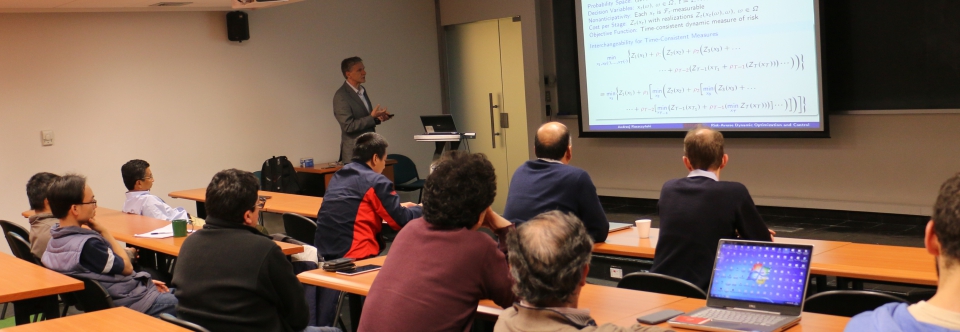
International experts in Stochastic Optimization met at Universidad de Chile’s Center for Mathematical Modeling. During ‘An afternoon on Stochastic Optimization’ Seminar, they analyzed and discussed cutting-edge issues in this area.
“This activity aimed to deliver to Ph. D. and postgraduate students what is happening in Stochastic Optimization in the world i. e. optimization of systems with uncertainty in several areas both in theory and applications,” explained CMM director Alejandro Jofré, who organized the activity.
Shabbir Ahmed from Georgia Tech, Johannes O. Royset from Naval Postgraduate School, and Andrzej Ruszczynski from Rutgers University got together at the activity before to join in the XIV International Conference on Stochastic Programming, in Buzios, Brazil, from June 25th to July 1st.
While Ahmed talked about uncertainty in discreet systems, Royset addressed the dynamic uncertainty. Finally, Ruszczynski exposed a model for risk quantification in areas such as mining, energy, building, and in civil engineering.
“This last talk gave us an outside the box perspective. At the end, it allows to you to consider unlikely, but very harmful scenarios. The model can support your decisions in the real world, in different contexts such as electric generation or medical research, by incorporating a measure for risk”, explained the CMM scientist Ernesto Araya, who attended the seminar.
The talks
The professor at Georgia Tech explained how various classes of integer programming models under uncertainty can be reformulated into deterministic mixed integer nonlinear programming (MINLP) formulations involving nonlinear functions of binary variables that exhibit a diminishing marginals property known as submodularity. This talk discussed approaches to exploit this submodularity to develop effective mixed integer linear programming (MILP) based methods for such MINLP problems.
For Royset, approximation is central to many optimization problems. The supporting theory provides insight as well as a foundation for algorithms. Motivated by applications in statistics and stochastic programming, the researcher has laid out a broad framework for quantifying approximations by viewing finite and infinite dimensional constrained minimization problems as instances of extended real-valued lower semicontinuous functions defined on a general metric space. Since the Attouch-Wets distance between such functions quantifies epi-convergence, the expert says it is possible to get estimates of optimal solutions and optimal values through estimates of that distance. In particular, near-optimal and near-feasible solutions are effectively Lipschitz continuous with modulus one in this distance.
Ruszczynski focused on modeling risk in dynamical systems. He discussed the property of time consistency and the local property of dynamic measures of risk. Special attention paid to discrete-time Markov systems. During the talk, he refined the concept of time consistency for such systems, introducing conditional stochastic time consistency. He also introduced the concept of Markovian risk measures and derived their structure. This allows deriving a risk-averse counterpart of dynamic programming equations. Specialized solution methods for infinite-horizon models were presented. Then he explained how to extend these ideas to partially observable Markov chains, derive the structure of risk measures in this case, and develop dynamic programming equations. Finally, he discussed applications of the theory to risk-averse clinical trials.
