
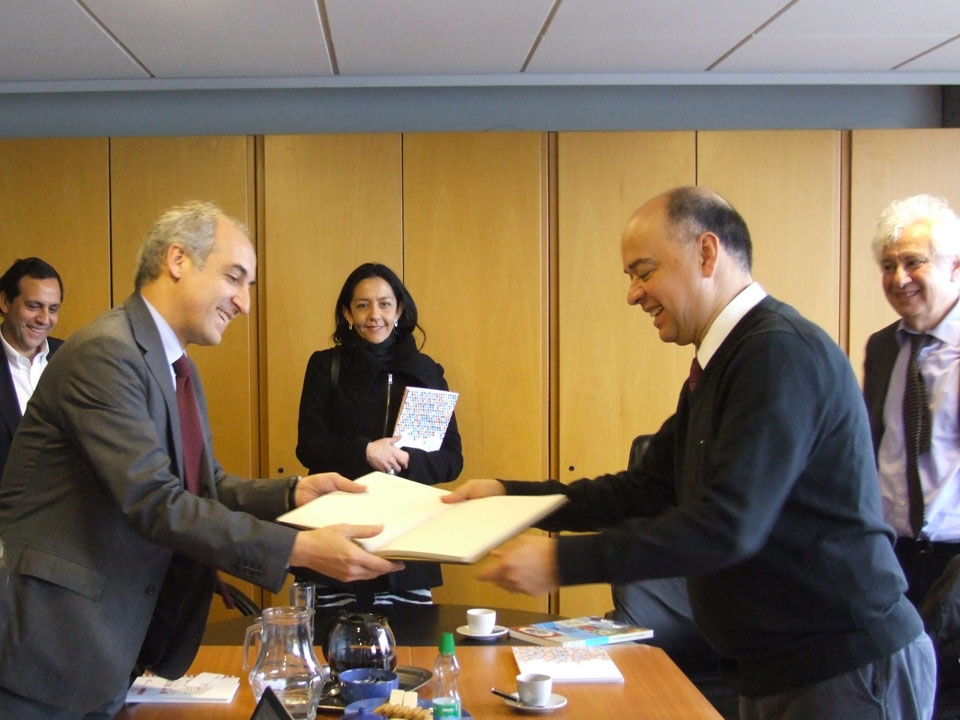
“The Center of Mathematical Modeling (CMM) is being the tip of the spear”, highlighted Maximiliano Santa Cruz Scantlebury, chief executive of National Institute of Industrial Property (Inapi) when talked about the strategy of this institution to promote the protection of the industrial property in Chilean universities. He said that in a meeting at CMM where Inapi’s legal and technical support where explained to researchers.
In the case of the center, this strategy aims to protect the knowledge generated by the researchers working at CMM. Thus, it will allow improving the culture of innovation, as well as the transfer of successful innovations to the market and the society in general.
Today, the CMM does not own the exclusive rights of any patent, but it is considered the developer of these patents. Hence, the rights of the first patent, dating 2007 and developed by the Forestry Laboratory, were granted to the University of Chile. On the other side, the Laboratory of Bioinformatics and Mathematics of the Genome (LBMG) can claim to have developed five ones, such as the method for the design of oligonucleotides for molecular biology techniques, which were granted by USA, South Africa, Austria and Mexico. Precisely, the CMM wants to start taking more control over the industrial property, as well as to increase the number of its own developed patents.

The national context
Indeed, this new strategy is seen both as an opportunity and a challenge, especially since the Chilean legislation on intellectual property is still becoming established.
A good reflection of the weak awareness of patents in the country is “U Cursos”, a digital teaching platform created by Facultad de Ingenería of Universidad de Chile. In spite of having being run for 12 years, it has not been patented yet. This explains the urgent of Inapi not only on focusing on strengthening its role in Latin America but also on moving closer to academic affairs.
A patent is a type of intellectual property, such as trademarks or copyright are too. It is a set of exclusive rights granted by a state to the owner of the asset. It empowers to exclude others from making, using or offering for sale the invention. In addition, it gives the ability to take a legal action under civil law to try to stop others from these actions.
