
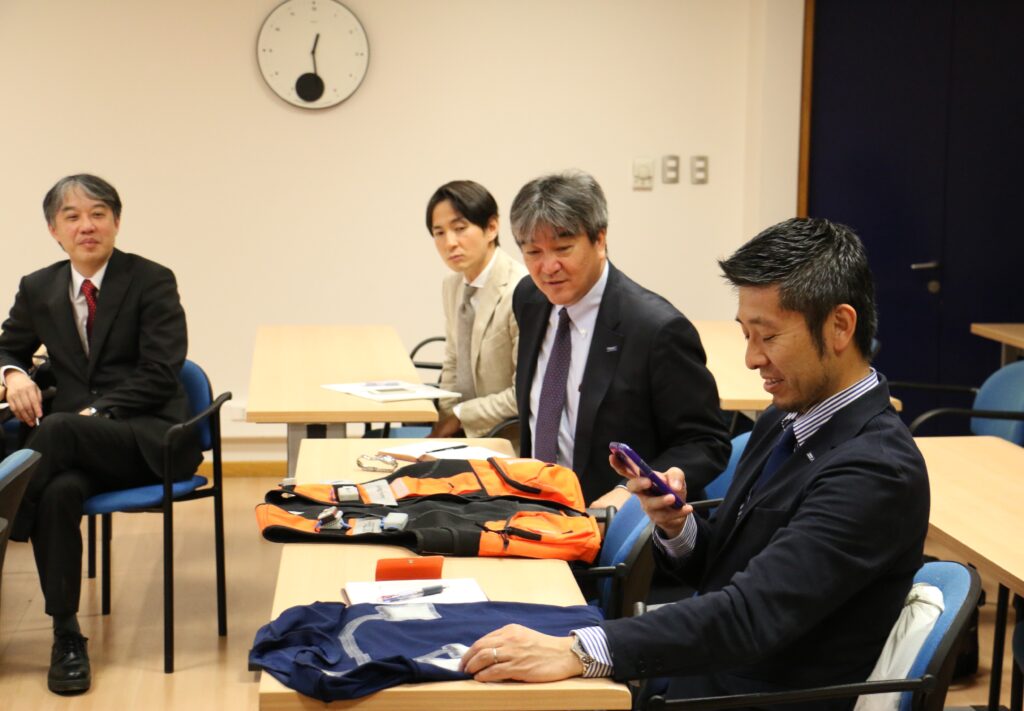
Members of two Japanese corporations, Nippon Telegraph and Telephone Corporation (NTT) and Toray Industries, visited the Center for Mathematical Modeling (CMM) of FCFM-Universidad de Chile to discuss an ongoing collaboration on wearable sensors, within four intense working days of meetings and a field trip to a Codelco’s El Teniente mine.
CMM is addressing how to automatically analyse the massive medical data which can be gathered by Hitoe over long periods of time.
Hitoe, is a special T-shirt which uses a composite conductive fiber material developed by NTT and Toray, in order to capture a very accurate cardiac signal (ECG) conveyed to a cell phone by a Bluetooth transmitter developed by NTT. This will allow its integration to the Mobile Monitoring Station (MMS), the sensor-filled jacket that keeps track of environmental conditions such as noise, light and particulate matter levels. MMS was the winner of the 2013 Intel Global Challenge at UC Berkeley and now it will also be able to detect signals of mental fatigue through the heart signals.
“Hitoe is a flagship project in Japan, where it is already being used for sports. But CMM will implement the first worldwide testbed in industrial operations,” pointed out Eduardo Vera, CMM’s Chief Innovation Officer who is leading the Chilean research team.
Vera and his group in collaboration with BNI (Biomedical Neuroscience Institute) of Universidad de Chile has studied the mental fatigue and the levels of attention based on the electrocardiogram (ECG) of 17 industry workers performing cognitive games in the early mornings and late afternoons of an extended period of time. The aim is to analyze the relationship between the hours slept the previous night, the alertness that the worker shows and the level of fatigue observed in the ECG. After analyzing this process with computational intelligence tools, a date base was created, whose results will be known shortly.
“We want to protect the worker, and prevent him from the risks and accidents due to fatigue”, said Jetro Gainza, an electrical engineer graduate and member of the Chilean research team. He explained that often the employee believes that he is able to perform a task that requires high level of attention when actually he is not. “Sometimes he is afraid to take a break, as it might be negatively judged by his boss. In both cases, we seek to bring solutions to this problem”, added Jetro, who stresses that this new T-shirt is very comfortable to wear. The shirt, as well as the jacket, is fitted with portable sensors that monitor the conditions of the worker and send the information in real time wirelessly to supervisors at ground level.
An international research consortium
NTT and Toray Industries from Japan along with Codelco and CMM-UChile, supported by technology start-up SoluNova Ltda., are carrying out the integrated product and service development of the smart-mining jacket and Hitoe.
Codelco expects their workers to carry out the new Hitoe T-shirt. Thus, the delegation of NTT and Toray visited El Teniente Mine, the largest underground copper mine in the world located in the Andes near Rancagua, to see how it would be implemented.
Besides, other centers like BNI-UChile are helping to understand the vast medical data collected by the T-shirt, something of great value to these Japanese companies. Thus, with the key support of the University of Chile, NTT and Toray Industries aim to commercialize the T-shirt, which incorporates machine-to-machine communication (M2M), a framework that allows the wireless transmission of data between electronic devices.
More photos in our Flickr gallery:
[alpine-phototile-for-flickr src=”set” uid=”89937484@N08″ sid=”72157649766115744″ imgl=”fancybox” size=”240″ style=”floor” row=”4″ num=”8″ align=”center” max=”100″ nocredit=”1″]
