
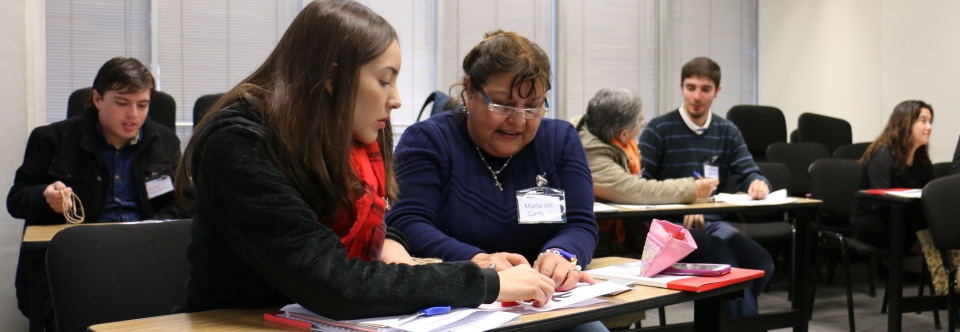
Solving problems is in our genetics. It is not always necessary to know something to do that. Often, acting only requires common sense, empathy or other factors not necessarily related to academics abilities. How then do you use that ability in the classroom? Can you use this innate ability to learn?
That is what Activando la Resolución de Problemas en el Aula (Activating Problem Solving in the Classroom, ARPA) is about. It is an initiative supported by the Center for Advanced Research in Education (CIAE) and the Center for Mathematical Modeling (CMM), both at Universidad de Chile. Since 2016, it is working with the five high schools of the University’s the Programa de Acompañamiento y Acceso a la Educación Superior (Program for Effective Accompaniment to Higher Education, PACE UCh) under the Office of Equity and Inclusion of the Vice-Chancellor of Student and Community Affairs, for the academic support of teachers and students.
A novelty for 2017 was the incorporation of the language area to the methodology of problem solving. It was presented to teachers and managers on April 5, during an induction session in the Faculty of Physical and Mathematical Sciences.
According to Patricio Felmer, ARPA director and CMM researcher, the project will allow “teachers and students to experience writing in a different way. They will have the opportunity to write, to express what they think while solving the writing problems that will be presented to them. This is how, in a transversal way, problem solving appears as a way of approaching schooling “.
In total, eight sessions in Language and eigh in Maths will be held from April to November. Here, teachers can learn the method and use it with their students.
“Solving problems is one of the key skills of the 21st century that impacts both academically and cognitively. It is demonstrated that solving problems improves self-esteem and the relationship with what is learned. It makes sense to applying in an accompanying program in highly vulnerable schools,” says PACE director Maribel Mora.
Use in classes
Teachers recognize the method is attractive for students as they are active in solving problems. For that, they use everyday examples and tools from their own experience. For the UTP head of Liceo Malaquías Concha, Pedro Rojas, the project is an “opportunity to make a more active work in the classroom, with joint participation of the teacher and his students.”
According to Cristián Contreras, teacher in Centro Educacional Valle Hermoso, “students welcome the method, work during classes and engage with the challenge, tackling problems according to their own tools. You see results, the boys dare, pull lines, do not leave the problem blank. That is a big change.”
Source: ARPA
