
In the last 5 years, the growth of the power of calculation of the processors for High Performance Computing has been achieved maily on having increased the number of available cores. At the same time, the evolution of the video games has stimulated strongly the power of calculation of the graphical cards, originating some of different type and great capacity of calculation.
In this context, the company NVDIA has developed three types of graphical cards, two can be programmed to execute arithmetical operations and whose denomination is GPU (Graphical Processing Units). The power of calculation of these cards comes from the great quantity of cores “graphs” that it possess, from the order from 2 to 4 hundreds.
“To use the capacities of calculation of a server with one or several CPUs and GPUs of brand NVIDIA is necessary to use the language of programming CUDA that is based in C and allows to implement applications in this hybrid system of calculation,” expleined Gonzalo Hernández, researcher of the CMM and one of the organizers of the workshop GPU Day.
As Hernández comments, some examples of applications that show a significant increase of these technologies are: linear algebra algorithms for dense matrices (Bookshop CUBLAS), fluid mechanics, molecular dynamics, processings images of magnetic resonance and simulation of of artificial neural networks.
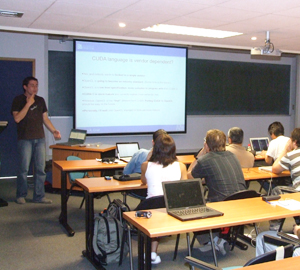
The workshop GPU Day, performed on Wednesday 6 of January in the Center for Mathematical Modeling, approached this one and other topics. During the day a practical tutorial of Programming was carried out for Systems CPU/GPU in which there was in use a servant CPU/GPU who was provided by the companies NVIDIA and INTEL. The tutorial was in charge of the student of doctorate in the University of Bristol, Philip Cruz. While Arturo Allel, NVDIA's Territory Manager, presented on the Supercomputers TESLA and Agustin March, INTEL's Laboratory Manager Software, Argentina, on INTEL's vision for HPC based on CPU/GPU.
The last talks of this activity were at the expense of Lorraine A. Barba, of the University of Boston and Rio Yokota of the University of Bristol.
“The workshop was a success for the excellent quality of the tutorials and the technical talks, as also for the people assist -about 60-” commented the researcher Gonzalo Hernández. “Given the rapid emergency of this technology, it low cost and the improvements in performance that is achieved in applications of the type data parallel, we believe that the proposed workshop was a contribution for the CMM to the scientific Chilean community in the learning of this technology, due to the fact that it included a tutorial programming CUDA and the discussion of the advantages and disadvantages of using system hybrids CPU/GPU in HPC's applications. “
