
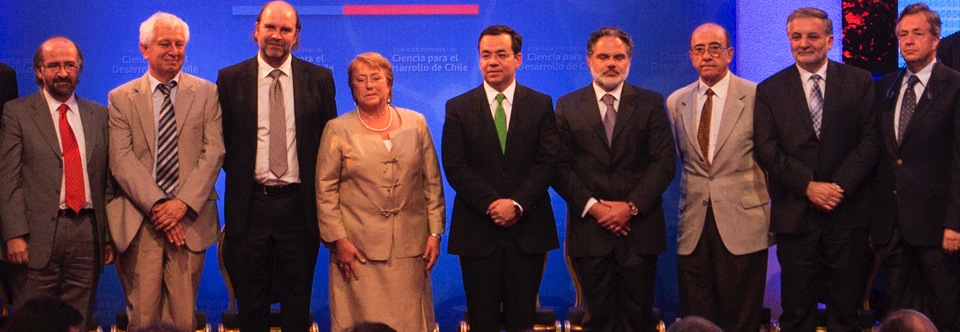
“Sciences have an irreplaceable role in the reflection about our projects and possibilities in the future. They show us the universe we are part of and the opportunities that are discovered to us. They help us to anticipate new challenges and innovate in the way we address these challenges. They make us to remember, with the selflessness and the passion they search for the truth, who we are and the human sense of everything we do.” With these words, the President of the Republic Michelle Bachelet announced the creation of the Science for the Development of Chile presidential committee, formed by the researchers of the Center for Mathematical Modeling of Universidad de Chile Servet Martínez and Rafael Correa along with 33 prominent experts in the topic from other institutions.
“The goal of the committee is to generate ideas and ways in order to enable the sustainable development of science over the time, as part of the national culture and having an impact on the overall activities of the country,” said Servet Martínez, who also is vicepresident of the National Council for Innovation.
“The first aim is presenting a proposal to strengths the science in Chile, to make the scientific research a pillar of our national development and our international insertion,” explained the President.
“An important point should be referred in the document is the issue of the institutional framework for the science development. And this is closely related to the President’s announce about the creation of a Science and Technology Ministry. That point is of great relevance. Many scientists have been insisting for years on the importance of such a ministry,” explained Rafael Correa, “today, there is not an institutional framework for the science development. Conicyt exists, but it is an agency that generates programs, instruments to fund the science at most. A policy of science development cannot be reduced to programs for science funding. It must go much beyond that, defining priority areas and, on that basis, what excellence centers will be funded and, mainly, will continue their work over the time. Other point of major relevance, that must be rigorously reviewed, is the scholarship policy. It is not just about giving a lot of scholarships.”
In the ceremony at La Moneda presidential palace, the head of the government announced changes to the limit of ten years to the State support to the Research Centers of Excellence –such as the CMM– created under the figures of ‘Basales’, ‘Fondap’ and ‘Milenio’.
“All around the world, this kind of centers are supported in a permanent way by the State, enabling a long-term execution of research agendas that require a more complex and more multidisciplinary scientific work. For that reason, it is not reasonable that they have to operate by their own after ten years,” pointed out the President Bachelet.
