
Dr. Michal Kowalczyk and Dr. Juan Diego Dávila participated in an interdisciplinary study analyzing the generation and the properties of defects in liquid crystals. This research was conducted in collaboration with Marcel Clerc, head and researcher of the Physics Department at the University of Chile and Estefanía Vidal, master student in Physics.
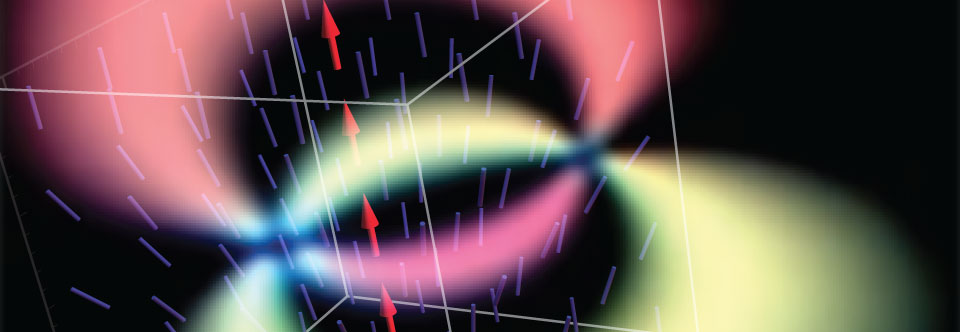
“The study explains the emergence of patterns in the orientation of liquid crystal molecules, called vortices or swirls. These vortices are created in pairs, one with positive charge and another one with negative charge, but with different energy”, said Clerc.
The results of this research were published in the article “Symmetry Breaking of nematic umbilical defects through an amplitude equation” in the journal Physical Review on July 18th.
The interdisciplinary aspect is a relevant feature of this research. As Dávila highlighted: “It has been very interesting to interact with scientists coming from other fields. Methods are slightly different and it is stimulating to share ideas. It has been easy to work in the team because they were willing to explain and to listen, and they have a wide knowledge.”
Another main achievement of this research is to be a gateway for a diversity of future developments. “The interaction of light with these defects generates optical swirls, which can play a crucial role in quantum computing, computers based on light for transportation and storage. Currently these optical swirls are used as optical tweezers and Image Filters”, pointed out Clerc.
Partial differential equations theory, amplitude theory, amplitude equations, bifurcation theory, and solvability conditions were the tools used. Interactive simulations, experimental mathematics allowing to develop intuition of physical phenomena in an efficient way were also key in this research that took one and a half year to be completed.
