
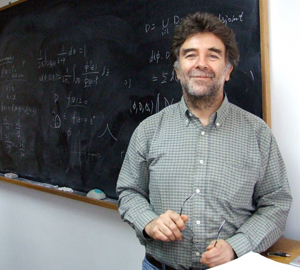
Patricio Felmer, Professor of the Mathematical Engineering Department (DIM) andesearcher of Center for Mathematical Modeling (CMM), will carry out a course on solution of problems for teachers of the first elementary cycle, which tries to incorporate in the teachers certain capacities adapted to their level of education, in the frame of the Courses Bicentenary organized by the Vice-rectory of Research and Development of the Universidad de Chile for this summer.
Especially, the course of ” Resolution of Mathematical Problems for the First Elementary Cycle “, lasts 25 hours, for one week. That means, it has five daily hours, and begins on January 4 at 08:30 hrs., in the School of Physical and Mathematical Sciences (Beauchef 850, Santiago).
The Prof. Felmer makes clear that ” when a person can calculate, reason, solve problems, can take all these things and bring them into a game. Usually it is about non routine problems, that, in the training of the teachers they are not very present. But now, with the curricular setting, the solution of problems appears in an explicit way in all the curriculum axes: in numbers, geometry, or information and random. It turn up in a transversal way. Then it is an important element for the teachers in exercise to handle this to the level that they teach “.
The course find out about the knowledge of the teachers and of incentive translated in problems to solve, of diverse complexity, proper teachers discover and establish certain methodologies of work.
“There are some typical ways of trying to solve a problem. I mean ' typical forms ' because there is no 'a' form to solve problems. Sometimes is a 'drawing', a diagram; other times, an analysis by contradiction; and lastest to see particular cases, get the general idea, etc.”, states Prof. Felmer.
“Then, as there are no recipes, what we want is see teachers working on problems, and from that experience with our incentive and help, at the end of the course they will showing which would be the necessary methodology, because that methodology is the one that children have to use from now on”, adds.
It is a question, according to the academician, of ” make themselves questions, of discuss with the classmate. We are going to do a lot of work in group.” And holds that ” we in general are not going to raise this in the attitude ' teachers look, problems are solved like this. These are the different technologies, now, apply them '. We are not going to use this outline, we are not going to teach them. We want from their own reality, with discussion between them and our help, they will be capable of discover their capacities and at the end of the course they can be able to manage certain methodologies.”
Confidence by themselves and design of activities
“Our goal is to extract the best of the teachers”, Prof. Felmer says. And he warns “mathematics is full of questions, is a science as all, and uses methods. Sometimes, the people prove one thing and other completly different, try one, try other one. Then we want invite teachers to this game, to make them understand the mathematics a bit more real and that they also discover they have more capacities of what they think.”
Besides that the teachers grow in this sense, the course expect they could design an activity with their students, including aims, activities and ways of evaluation.
“We hope that at the end of the course, teachers will be able to raise their students a strategy of resolution of problems to learn mathematics in the elementary level”, made clear the academician.
Commitment with the Public Education
“Through these courses, we want our society see our interest for the education of the whole country but especially for the public education. Now, this kind of experiences in which the Universidad de Chile has been involved should serve for a higher link. We hope that product of these Courses Bicentenary generates a new look from the Universidad to confront with more commitment and force, the topics of education of the country ,” he said.
It reflect, to his judgment, “to the type of project that we have. Saying 'we' , I am speaking principally about the environment of the Center for Mathematical Modeling- Department of Mathematical Engineering. We have had programs and projects of education, and hope this activity also points us towards the future with a great commitment in this task. Then, the Universidad de Chile is compromised with the education, the Public Education is its center, but also it has many things to do.”
“The sense of this Bicentenary Course: is to make the society see how worried we are, to deliver new tools to the teachers in order they improve their teaching, but also realize that it is necessary to do more,” the Prof. Felmer concludes.
The Bicentenary Courses
These days of update are designed and dictated by out-standing academicians of the Universidad de Chile of several disciplines, pointed specially to teachers of elementary and junior high education who work at the classroom. It contemplate developments in various matters and its own methodologies; besides a publishing line, which complements and supports the development of the educational occupation of the teachers.
List of Bicentenary Courses – Mathematics
– Information and random, Prof. Alejandro Lopez Collazo, Code SENCE: 12-37-8356-22.
– Arithmetic in the adjustment curricular of the first elementary cycle, Prof. Cristián Reyes, Code SENCE: 12-37-8358-20.
– Discreet mathematics, Prof. Iván Rapaport, Code SENCE: 12-37-8357-26.- Linear programming, Prof. Jaime Gonzalez, Code SENCE: 12-37-8357-25.
– Approximation of numbers, Prof. Jaime Humberto Ortega Palma, Code SENCE: 12-37-8373-51.
– Mathematical reasoning in Classes of Geometry, Prof. Leonor Varas, Code SENCE: 12-37-8358-49.- The Statistics in Junior High Education, Prof. Nancy Lacourly, Code SENCE: 12-37-8357-99.- Pedagogy of mathematical fractions for the second elementary cycle, Prof. Paul Dartnell, Code SENCE: 12-37-8373-66.
– Resolution of mathematical problems for the first elementary cycle, Prof. Patricio Felmer, Code SENCE: 12-37-8358-13.
– Graphical tools for the education of the probabilities, Prof. Pierre Paul Romagnoli, Code SENCE: 12-37-8358-58.
– The geometry of the forms and it measurement. Foundations and applications, Prof. Raúl Gormaz, Code SENCE: 12-37-8373-67.
– Divisibility and prime numbers, Prof. Salomé Martínez, Code SENCE: 12-37-8373-65.- Discreet and recreative mathematics: transverse strategies for the solution of problems, Prof. Flavio Guíñez, Code SENCE: 12-37-8373-55.
– Improving the class of mathematics in the elementary cycle by the study of cases, Prof. Cristián Reyes, Code SENCE: 12-37-8363-12.- Numbers and algebra: contextualización of contents, Prof. Jaime Gonzalez, Code SENCE: 12-37-8373-47.
More information about the courses in: http: // www.uchile.cl/u.portal
