
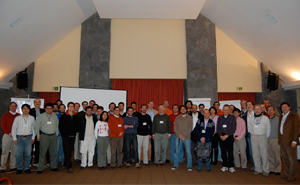
New astronomical projects in Chile such as the ALMA and LSST observatories will generate a massive amount of information as has been the case for biotechnological data and soon the financial industry. Analyzing data storage, transmission and processing will require, amongst others, state-of-the-art IT and mathematical development. Considering the issues at hand, the Center for Mathematical Modeling (CMM), FCFM – Universidad de Chile, organized a Symposium in Pucón in 2009 titled: “Advanced Mathematical Tools for Frontier Astronomy”.
The goal of this activity was to identify the unsolved problems and consequently define the technological, mathematical and IT developments required to support researchers generating large volumes of data.
For CMM´s Innovation Manager, Eduardo Vera, astronomy projects developed in Chile represent an opportunity to produce new-fangled knowledge. “There is no current existing technology that can make sense of the massive amount of data available and in five years time the needed technology will make a difference and the developments we may produce today may be applicable to areas beyond astronomy, such as finance and biotechnology” he stated.
“When referring to the financial industry, areas such as market monitoring, financial analysis and risk management data have grown exponentially and tighter, close-fitting analysis in real time, specially in critical moments shall be mandatory”, stated Alejandro Jofré, Deputy Director of CMM .
Researcher Alejandro Maass, underlined the challenge biotechnology sets forth with the requirement of enormous amounts of data in requirements in a reduced amount of time. “Development in techniques allowing to obtain data of the entire omics chain in a few weeks is a challenge that changes queries on biological data on a daily basis and in addition the open question on how to make it useful to the biological process that sets it in motion, remains.”
The Pucón Symposium 2009: “Advanced Mathematical Tools for Frontier Astronomy” held August 6-9 was attended by scientists working on the most significant astronomical projects in Chile, such as ALMA and LSST. Delegates were researchers from Carnegie Mellon, Washington, Georgia Tech, and Universidad de Chile; in addition to experts in mathematics, biotechnology, finance, imaging and photonics, amongst others.
