
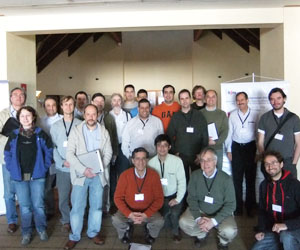
As it has happened with biotechnological information, astronomy generates a massive amount of data, especially in our country, where sooner the astronomical projects as ALMA and LSST will be operating. The storage, as well as the transmission and analysis of this information need important computational and mathematical developments, and for this reason the CMM has prompted a meeting with scientists from different fields to discuss how to meet the challenges that lie astronomy of the future.
Pucón Symposium 2011 was attended, among others, Pavlos Protopapas (Harvard University), George Djorgovski (Caltech), Giuseppe Longo (Napoli) and Chris Miller (Michigan), who was co-Chairman of the meeting along with Eduardo Vera. Also Tony Tyson (LSST director), Bruce Elmegreen (IBM Watson Research) and Ricardo Baeza-Yates (Yahoo Research) made their presentations remotely from California, New York and Barcelona, respectively.
“Unlike the first version, in which more foreigners came and the presence of Chilean astronomers was small, this time the national call was significant, among others we have gathered to an emerging community of astronomers, especially interested in understanding how they will handle data massive, and the first conclusion is they cannot do it alone, but require a multidisciplinary work that applied mathematics and computer science play a fundamental role,” said Eduardo Vera, NLHPC‘s director and CMM’s manager of innovation.
In this sense, Pavlos Protopapas highlighted the effort to bringing together specialists from different areas in a same symposium. “For me this is one of the best conferences, because this is what I believe, the multidisciplinary work in astronomy.”
Eduardo Vera explains that the first Pucón Symposium 2009 served to strengthen ties and begin some initiatives that have been developing over the past two years with AURA and Harvard. According to the Director of NLHPC this last meeting has further validated the idea of interdisciplinary work, where the CMM has much to contribute.
[box] Aware of the role that mathematics play in astronomy, the Center for Mathematical Modeling decided to create an Astro-informatic Laboratory, that aim is to develop human skills and mathematical tools that support the major challenges facing astronomy to become a science of large volumes of data. Undoubtedly, the study and understanding of massive data require the active support of specialists in mathematical modeling, data mining, statistics, image processing, multidimensional data visualization, data storage and processing, among other disciplines. Currently, the lab is working on automated detection and classification of astronomical objects, analysis and classification of transient events, interferometric image reconstruction, and management and modeling of astronomical data. All these projects are being developed by mathematicians and engineers in collaboration with astronomers in Chile and other foreign universities (Harvard, Caltech, Michigan, Georgia Tech, Carnegie-Mellon, Washington, Federico II Napoli).[/box]
More images and interviews here (video – Windows Media)
