
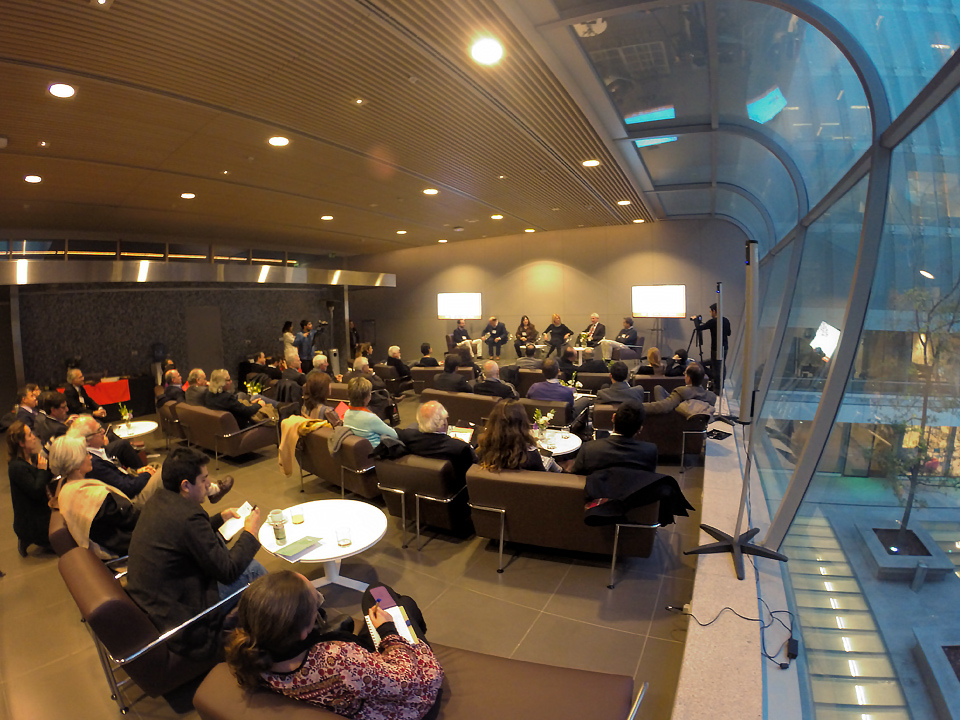
Aiming to discuss the impact of mathematics and, particularly, the work of the Universidad de Chile Center for Mathematical Modeling in the society, CMM researchers met with a group of 52 businessmen, decision makers, and opinion leaders. Scientific, economic, business and social challenges were main issues in the seminar.
During the meeting called ‘Expediciones Urbanas: Matemáticas, Sociedad y Arquitectura’, organized together with Red de Alta Dirección Foundation (RAD), researchers Servet Martínez, Alejandro Jofré, Salomé Martínez, Alejandro Maass and Ginés Guerrero spoke about the scientific work and technological transference the center makes in education, mining, genomics, and supercomputing.
Claudia Bobadilla, executive vice president of RAD, opened the session. She announced she hoped to “provoke” the public with the speakers. The businesswoman also stressed the need to discuss the business-science relations.
Servet Martínez invited the audience to join in the CMM’s adventure. He started explaining how mathematics, which already has more than four thousand years, has been essential to the human understanding of nature. A fundamental operation has been reducing data to get meaningful information. This phenomenon continues today with the processing of large volumes of data. In this context, he recalled the creation of the center in 2000. The researcher told how it was something new for that time. This, to the point that the law innovated for its operation. He also deepened in the CMM’s vision of the country. The Center understands the investment in science and technology is comparable with a small US state. “CMM sees Chile as a great university. In this way, it has built its networks and developed its work,” he said.
Then came the turn of CMM Director Alejandro Jofré, who talked about the research in mining. He focused on the possibility of developing mathematical models and algorithms by using low-cost sensors that collect a large number of data of the conditions of the mines. Managers now can make decisions knowing risk levels, which opens a new paradigm for Mining. Harmonizing measures proposed by local machines with global decisions taken by humans is a challenge. And these resolutions consider different levels of risk.
He related this work with innovations the center is conducting in apparently distant areas. “We discover patterns to make decisions. For example, members of Astroinformatics Laboratory developed a model to discover real-time supernovae. These patterns serve to discover stars and to detect displacement of mining slopes,” he said.
Salomé Martínez, Laboratory of Education director, launched a provocative question. “Who knows math well enough to teach it in 3rd grade?” she said. This interrogation has guided worldwide research in this area. And the attendees thought about that. She stressed mathematical learning affects the civic virtues and citizenship education. It promotes critical and independent thinking, problem solving, common sense, the ability of argument, perseverance, work team, and other abilities.
To address the challenge of improving Math teaching, she highlighted the deep knowledge of CMM on the matter. This advantage allows them to separate the wheat from the chaff and to teach meaningful contents. She also emphasized the center’s capacity to convene a multidisciplinary team. The team to address this huge problem needs teachers, psychologists, designers, and sociologists. Finally, the mathematician showed in a video some developments focused on pre-service and in-service teachers’ training. For example, REFIP collection of books for Education students and Suma y Sigue b-learning program.
Genomics and supercomputing
Alejandro Maass was the fourth speaker. In his view, Chile was right when started genomics developments early. He explained how the sequencing of the human genome meant a revolution. Today the challenge is to read the different parts that make up the genome to create new developments for human health. Something similar is happening with the different genomes sequenced by CMM. Despite some advances required large investments in the past, they have been key in next developments such as the Atlantic salmon genome, sultana grapes, bioleaching, and others. He also highlighted the recent work with the international consortium that deciphered Atlantic salmon. He closed his presentation telling how Chile will fund a part of the Tara Oceans project in metagenomics. This program will characterize the diversity of the Chilean coast.
At the end, Ginés Guerrero compared the current competition to build the most powerful supercomputer between US and China with the space race between US and USSR in the 60’s. In this context, Chile seeks to build a computer for the citizen’s welfare. “It must contribute to the development of science, State institutions, and companies (…) as a public policy,” explained the NLHPC director.
Then, a round of questions and answers with the audience came and the activity ended with a dinner.
