
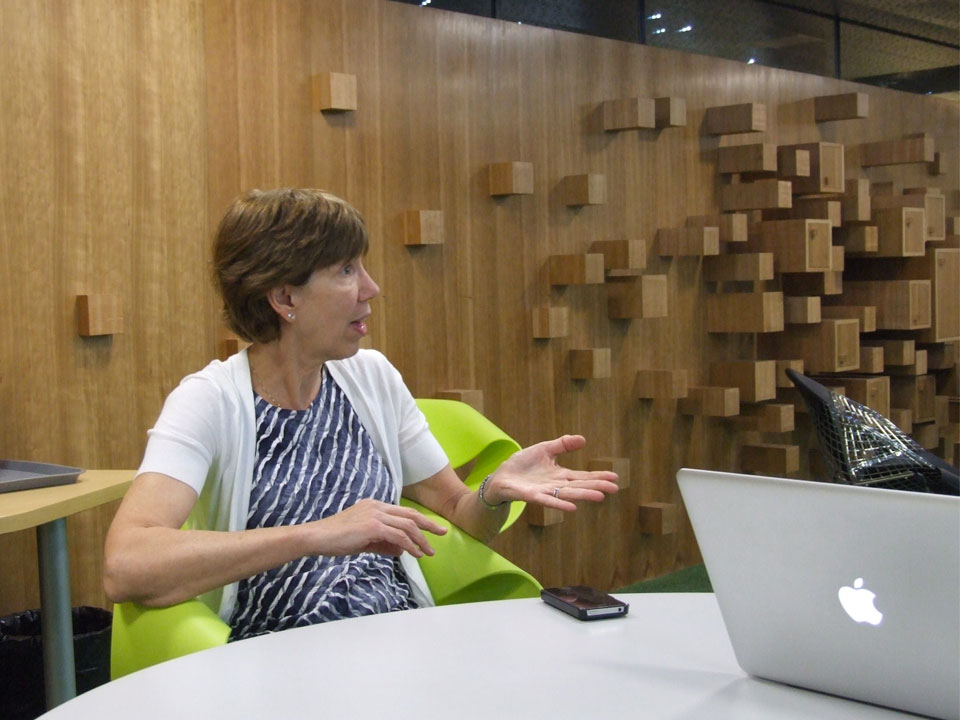
Suzanne Chapin (SC) is one of the most prominent experts in Mathematical Discussion in the classroom. She is Professor of Mathematics Education at Boston University where she lectures courses and conducts research. Her work covers the areas of gifted education, curriculum design, teacher professional development in mathematics, and teacher and student discourse in mathematics.
She visited Chile in January to work with the Education Laboratory of the Center for Mathematical Modeling from Universidad de Chile (CMM) to discuss with its members how to support teachers to facilitate mathematical discussion in order to help kids to learn mathematics better.
CMM: Most of people think you can’t discuss Math, how do you conclude we need to mathematical discussion?
SC: If you think back in terms of learning theories, there are a lot of strong theories about the role of social interaction in learning. We know that having an opportunity to reflect on ideas, to connect those ideas to what we already know, to generalize these ideas, help us to learn. For a very long time, people not thought the mathematics lent itself to conversations, but now they are becoming aware that could be extremely beneficial.
CMM: Why must Math teachers promote discussion in the classroom?
SC: There are a lot of different reasons. One is that students are actively engaged with discussion and going to learn more. If people are just sitting listening, we all know they will dream, right? They won’t pay attention; sometimes, the instructions are going by very quickly and, because there is not interaction, they are not able to stop and ask questions. And they begin to think mathematics is a subject that I don’t have the sense of: I have to memorize something that somebody told how to think about it.
CMM: How does the math discussion works?
SC: You use discussions when you have to talk about ideas can be generalized. Or when you are trying to provide evidence. It’s not we will discuss whether 3×5 is 15. That is a fact, right? We have to discuss complex problems. And, to be a good problem-solver, you need to be flexible in your thinking. Solving the problem is an experience with different ways of approach. For example, young children are not mathematicians; they don’t need the same kind of explanation for a problem. But they need to have an understanding and teachers help them to make sense of that. Discussion is an opportunity for students to take what they already know, connect it to new knowledge, and remember it better.
CMM: What are the benefits for the teachers?
SC: As a teacher, I don’t know what you are thinking as a student. So, I know that with a test I take every week or every two weeks. Here, I can ear each day your understanding on what we are working on; I can use this as a form of assessment, and adapt the work for the next day according to your understanding on Mathematics. You are also trying to teach students to provide evidence. With this method, we are trying to help students to link their steps and their knowledge to actual evidence or facts they are using. We don’t often do that when we just calculate. Because the goal of teachers is to make students become productive citizens, we can use these talks to reach that goal: they can articulate ideas, talk about those clearly, and support those.
CMM: Have you measure the progress of the students who learn with math discussions?
SC: Right now I’m working in a project with undergraduates who are preparing to be elementary school teachers. They use materials totally discussion-based. They are gave some problems, work with their groupmates and answer questions. The teacher goes from group to group listening, helping, but when they are all together, they discuss about big mathematical ideas. And teacher makes sure that everyone understood completely the problem. Doing this, we found students using this method have very high significance gains in their achievements of Mathematical knowledge. Next stages, we will start to follow these students as they become teachers and see if this this way of teaching is translated to the classroom.
CMM: You talked about productive talk… What does it mean? And what is the difference with the “unproductive talk”, if exists?
SC: Productive talk is talk about academic subject that is focused on helping students reason and make sense of the content. But not all talk is productive. You have to be careful. Just having children talking is not always guarantee they are going to learn. You must have very specific mathematical goals and, then, design the questions for the discussion according to those goals.
CMM: With this method, teachers must to prepare classes in a more exhaustive way. It is like writing a script for every class. In Chile, elementary teachers must prepare not only Math, also other subjects, where can they do it to prepare the discussions?
SC: This method is more complicated, but more interesting, because you don’t know what students will say. Then, you have to listen very carefully to what they say and think about the questions you will do and what student will have to answer the question. It takes a little more work. However, many teachers have told us they prefer to teach this way because it is more enjoyable. It is intellectually stimulating and it is also very rewarding, because the students liked better, they like to be involved and doing things rather than being passively.
CMM: How can teachers promote a safe environment for discussions? Without bullying, laughs or fear to make mistakes.
SC: The first thing is you have to establish is the classroom culture. We have to be very respectful of each other and we won’t make fun. We won’t laugh about wrong answers or say “what stupid” or say any derogatory comment. And then, we also talk about students have to work hard in understand each other; trying to make sense of each other’s ideas. And when you establish that, which is the first thing teacher must do, we have some rules about how we are going to talk together. Students follow them and they like them a lot.
CMM: They follow and like them a lot?
SC: They do. Because, we work in places where we can say some things we are not completely clear, or we don’t know everything and we make nervous. And in Mathematics we have to figure out a right answer. Then, we have to think in an environment where everybody can learn and contribute to the answer at the same time, not only two people that understand right away. Actually, the teacher can learn at the same time. Then, the environment is very important. When that environment is established, it’s very easy to contribute and participate. And students like this a lot.
CMM: Is the same for all the cultures?
SC: In general, people, regards of their culture, are respectful of each other and want to be respectful of each other.
CMM: Even kids?
SC: Even kids. Kids, when you ask what they want, they want to be liked, be happy. They want to be successful. They want to learn. When, you put that possible, they blossom. These ideas are more human characteristics across cultures.
CMM: What does kind of skills need a teacher who wants to use math discussion?
SC: There are a number of things. They have to feel confortable about Mathematics. If there is a part of Mathematics they don’t know or they are not completely sure of, they have to be OK when saying “Let’s go back to that tomorrow. I will look something, all right?” Because not being sure about the answer could be unsettling. But, knowing and understanding Mathematics is very important. The second thing is teachers are, we say, ‘talk moves’. They have to learn they can help to facilitate the discussion. Students have to be able to express their thinking and to listen the thinking of the other students. So, we have a couple of rules or tools to teacher facilitates that: one thing is that you may to ask a question to a student and, let’s say they give you an answer, but is not good enough, you can say, “Tell me more about what are you thinking” or “Give me a little more information”. Then, you can go to other student and say, “What can you think about that” or “Restate with your own words what the idea was”. Now, sometimes, nobody is paying attention. And we don’t want to create a bad environment. Then, you can ask to the student to repeat the statement and others can pay attention and answer the question. Sometimes, teachers forget they know the material very well and forget that learner is just learning it. And they need to slow down the pace. Discussion and conversation allow you to slow down the pace to think about answers.
CMM: But slowing down the pace looks like an expensive cost of time in these times. A luxury…
SC: Hahahaha.
CMM: To slow the pace, teachers need to teach less content every year?
SC: You don’t need to do one hundred problems to understand something. You need to do some, and you need to think about them. But less around certain content is fine, but we have to cover all the important content. They don’t need to practice during classes neither. Classes are for understanding the ideas and practice is more for homework.
CMM: With the current methods, a teacher repeats the same lessons one year and another, then, students from different classes will receive a product of the same standards. What happens with this situation using this new paradigm?
SC: You have to remember the teacher is very important. Just because you are in a discussion, it doesn’t mean the teacher still does not give information. The teacher has mathematical goals for that class and those goals have to help him to think about what they want to. The teacher directs where you are going. That is the role of the teacher: to be sure that every group every year will reach the same goals.
CMM: How does a teacher choose the issues to discuss?
SC: In Mathematics, you have your goals and you have to think what is the content you want to cover and then you have to think what are the tricky parts, what are the part that confuse people and need more discussion: special cases, treasons behind something, procedures. In that sense, teachers need to have a big knowledge in order to explain things. The more students will understand the contents the more they will want to learn Mathematics.
CMM: Then, older teachers have an advantage: they know better where students can be stuck.
SC: That is absolutely truth. A young new teacher has many, many things to learn. This is where training and workshops and works like are done at CMM help them.
CMM: How do you do to lead the discussion, considering kids could get bored? They have a more concrete way of thinking…
SC: You have to make sure about the explanations have to be appropriate to the age of the students. It is not useful to think very young children are going to have a very theoretical explanation. That’s not going to be useful to them. It won’t make sense to them. When you are talking, you can use materials to explain something. They might use blocks or figures they are going to help to explain their work. However, to children it is not boring to hear each other talk.
CMM: Can you give me a number of tips to have productive talks in the classroom?
SC: Sure. One thing to start is putting the students to work in partners. Don’t put the smartest and the weakest students together. Put students are about the same. And try they talk about the Math. We call it ‘partner talk’. Now, students are talking, thinking, are trying to figure it out, maybe they have an idea and they are scare. But they realize some have the same ideas, they start to be confident about what the answer is. You don’t mix bright and weak students, because bright students will take over. Maybe, weak students have good ideas but they’ll need a little more time. Second thing is, when you ask a question, just wait. Count to ten before you call to anyone. Wait they think a little bit. And, next, they can talk to their partner. You have to wait.
