
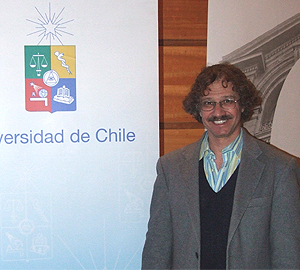
A few visits to classrooms were enough for him to confirm that some elementary teachers didn’tknow enough mathematics to teach children and something had to be done. Thechairman of the Department of Mathematics at Boston College (BC) -a highly selective Jesuit Catholic university in the United States with a commitment to both research and teaching- has beeninvolved in many boards and committees in USA concerned with the mathematicalpreparation of teachers. Also he is the founder and director of the CaseStudies Project at BC.
Invited bythe Fondef project “Tools for Training of Mathematics Teachers”,developed by CMM researchers, Solomon Friedberg participated at the workshop “Theability to teach mathematics of prospective teachers of Pre-primary and basiclevel’ (K-8)”, held in Santiago last June 16.
But this isnot his first visit to Chile. Last year, invited by the sameproject, he presented a series of talks on case studies, a method for improvingthe pedagogical skills of future high school teachers. Friedberg also ishelping the researchers involved in this project to develop their own casestudies in order to introduce this method in the curricula of Chileanuniversities. “They have done a really good job” he said impressed with the results of their year of hard work.
During thelast workshop, Solomon Friedberg talked about the preparation in Math of futureelementary teachers and why they need to know mathematics.
– How would be for you the ideal teacher?
At a basiclevel, both in Chile and USA, the teachers are teachers of everything;they are generalists rather than specialists. A generalist obviously has toknow how to teach, not just mathematics but everything else, but I think inparticular must have knowledge of the mathematics they teach and also theknowledge of how to explain it in the way that is appropriate for the age ofthe child.
– How do you prepare the future teachers to havethat mathematical knowledge?
When we areteaching mathematics for future teachers we do it very much with an eye onhelping them to communicate and explain the mathematics to the students. Thereis a separate course in math pedagogy, which gives specific tools, methods andobjects that that would help the future teacher. There is a blend, both courses–math and pedagogy- have some mathematics content and both courses are veryaware that they are teaching teachers with the goal of helping them be betterin the classroom.
The real focusis explaining the mathematics and making them (future teachers) think again and a high level aboutaddition, subtractions, multiplications, division, etc. The way we do it is givingthem homework problems such us how do you explain to the students that theycannot divide by zero? If a child does this -some specific calculation that raises a conceptual question- what would your response be?
We explainthat is important to use precisely language and precisely notation and we don’tdo it because is right; we do it to help the students.
– Some future elementary teachers are afraid of mathematics,how do you help them?
We have torecognize that there is a process and also there is a very personal kind ofissue. What I do is encourage the student to come and talk to me during myoffice hours. Sometimes when people are afraid the professors have to make anextra effort to reach out and say to the students please come to my office. Ihave had some people who were very afraid of making a mistake and I have to saypart of mathematics is trying things and not everything works, you have to bewilling to make a mistake in order to look forward. But every person is a bit differentin this regard. Their confidence comes from two things: one is from knowing andknowing that they know, and the second thing is from doing some mathematics anddiscovering that they can think mathematically.
– What is the mathematical thinking and how it can be learned?
At thebasic level we want all our teachers to be able to think mathematically. What Imean by thinking mathematically is solving problems in different ways and beingexcited when their children come up with a new way to solve the problem,recognizing that it is okay, it is even good and exciting.
We want ourteachers to be comfortable enough with their mathematics; comfortable givingexplanations to the child, knowing what are they teaching. We don’t wantsomeone to say dividing 3 by 7 is impossible, of course it is quite possible, butnot with a whole number answer.
– Who are responsible to teach mathematics toprospective teachers at Boston College?
Myuniversity got a very large grant to get faculty from the Faculty of Arts andSciences -English professors, History professors, Geology professors, Mathprofessors- involved with teaching our future teachers. The program created bythe University encourages these people to try and see teachers in action, visitschools and then teach classes to prepare future teachers.
Forexample, one of my colleges from the Math department has invented a new classfor future teachers about Euclid. He has his students reading the original text andtrying to understand the mathematical reasoning that is there and then explainit to other people in the class. It is a very rich experience for futureteachers have something like that and for the mathematician it is also an excitedexperience.
