
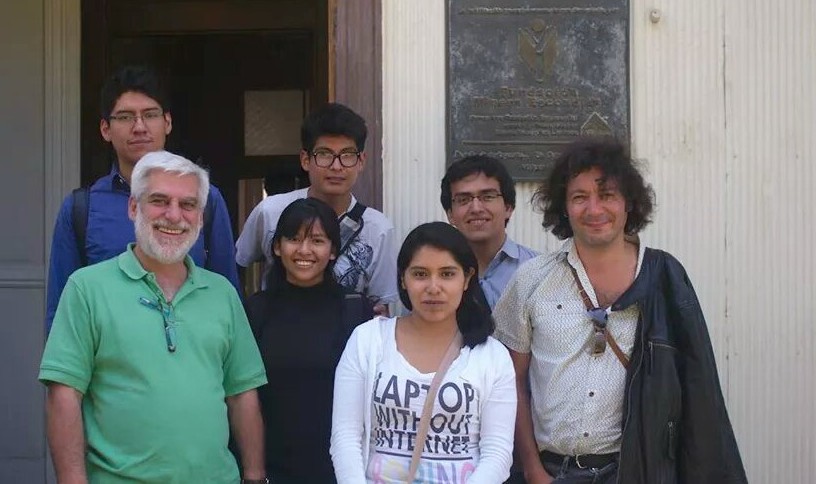
With three courses lectured by a group of prominent professors and the attendance of graduates and postgraduates from across Latin America, the 10th version of the School of Discrete Mathematics -organized by the Center for Mathematical Modeling of Universidad de Chile (CMM) along with the Millennium Nucleus Information and Coordination in Networks- attracted wide interest within the academic community and registered high levels of participation.
“It shows that it is part of students´ culture. It is embedded in the landscape of our Faculty and other science schools in Chile and Latin America,” pointed out Iván Rapaport, CMM researcher and member of the organizer committee since the first version of this event in 2006.
Algorithms, combinatorics, optimization, distributed systems and game theory were the topics learnt by the 40 students and 15 professors invited to the coastal city of Valparaíso.
Valentina Toro, president of the Department of Mathematical Engineering Student Union, was particularly interested in the course entitled ‘Majority Judgment: theory and practice’, given by Rica Laraki: “It was the first time that I attended the School and I am looking forward to participate in the future. I would like to know more about the different applications and development of this area of mathematics”.
Laraki, from the École Polythechnique of France, claimed that the traditional methods of voting do not work, since they often fail to elect the candidate sought by the voters. This model leads to paradoxes like Arrow’s impossibility theorem, which states that no rank order voting system can convert the ranked preferences of individuals into a community-wide (complete and transitive) ranking.
Other particularity of this event was the incorporation of Chilean lecturers to take the stand. It was the case of Roberto Cominetti, from the Department of Industrial Engineering of Universidad de Chile, who talked about ‘Dynamics of Non-expansive maps’. It has applications in network equilibrium, signal processing, discrete probability and adaptive learning in routing games, which consists on an individual learning that brings to a collective balance, for example, people taking daily decisions (as driving back for holidays) or how bees take the nectar of flowers.
The other Chilean was Gonzalo Navarro, from the Department of Computer Science of Universidad de Chile, who focused his talk on ‘Compact Data structures’.This tool allows one to work with large amounts of data by compressing it to a limited space of computer memory, while allowing to access and query the data without uncompressing it. This mechanism allows work faster. It is used by Yahoo y Google to find communities in the web, which means, websites that are connected thematicallywith each other.
“The difference between having data in Random Access Memory (RAM) versus bringing it from a disc is comparable to the fact of taking the sharpener of the desk where I am sitting versus flying to China to search for it and come back,” explained Navarro.
The School, which has been always held in the Instituto de Sistemas Complejos de Valparaíso, has been attended since 2006 by students coming from several countries from Latin America, Brazil, Ecuador, Peru, Mexico and Argentina.
